
What kind of sound system setup is needed for a 500-guest wedding?
What kind of sound system setup is required for a 500-guest wedding?
"How many speakers do I need for a 500-guest wedding?" is a question frequently asked of rental companies and hotel banquet venues—and one that is often answered incorrectly. Drawing on its library of solutions categorized by guest count, as well as real-world case studies of 500-guest weddings, Sinbosen proposes two practical, ready-to-deploy configurations: each consisting of four full-range line array elements and four subwoofers, with two line array elements and two subwoofers positioned on each side of the stage.
A 500-guest event represents a significant threshold. At this scale, the venue is typically a banquet hall filled with round tables, characterized by numerous hard, reflective surfaces and a considerable distance between the front and back rows. Furthermore, ceremonies often involve the simultaneous use of both lavalier and handheld microphones. The challenge lies not merely in achieving sufficient volume, but in ensuring vocal clarity, consistent coverage for the rear rows, and the prevention of low-frequency feedback buildup on stage. In this context, a line array is valuable because it narrows the vertical dispersion angle, directing acoustic energy across the audience area rather than scattering it indiscriminately toward the ceiling or rear walls. To complicate matters further, a single system must often adapt to three distinct requirements over the course of a day: the ceremony demands vocal clarity and high feedback resistance; the dinner reception requires uniform coverage that doesn't interfere with conversation; and the party phase calls for robust low-frequency energy and ample dynamic headroom.
Sinbosen provides two "4+4" reference configurations.
Option A: KA10 + KA21 (passive) | Option B: H-30A + 9006S (Active) | ||||||
Main expansion | 4 × KA10, 10-inch two-way line array; Wide 137 dB / Focus 140 dB; L-Fins adjustable fins support 110°/70° symmetric or 90° asymmetric coverage | 4 × H-30A, dual 10-inch active line array; 2200 W peak Class-D; 50 Hz–20 kHz, 137 dB; 100° × 15° constant-directivity waveguide; 32-bit / 48 kHz zero-phase DSP with RDNet remote control | |||||
Ultra-low | 4 × KA21, 21-inch passive subwoofer; low-frequency extension down to 29 Hz, maximum SPL of 138 dB, 1800 W peak power; birch enclosure with polyurea coating | 4 × 9006S, dual 18-inch active subwoofers; frequency response down to 30 Hz, maximum SPL of 142 dB, 7200 W peak power; adjustable crossover (50–400 Hz), and presets for cardioid/omnidirectional configurations. | |||||
Drive method | External DSP amplifier + standalone processor (e.g., A-4X / A-12X, DS-20Q, etc., paired with PA-2 or D-260) | Each cabinet comes with an integrated Class-D amplifier and DSP; functions such as crossover, EQ, limiting, and delay are handled internally, eliminating the need for an external amplifier rack. | |||||
Enter the market | Cabinet wiring, gain structure, and rigging must all be handled on-site. | Cabinet wiring, gain structure, and rigging must all be handled on-site. | |||||
Better suited | Fixed installations, rental/touring inventory, dedicated technical staff, budget-sensitive | Hotel banquet halls, tight load-in windows, mobile rental solutions | |||||
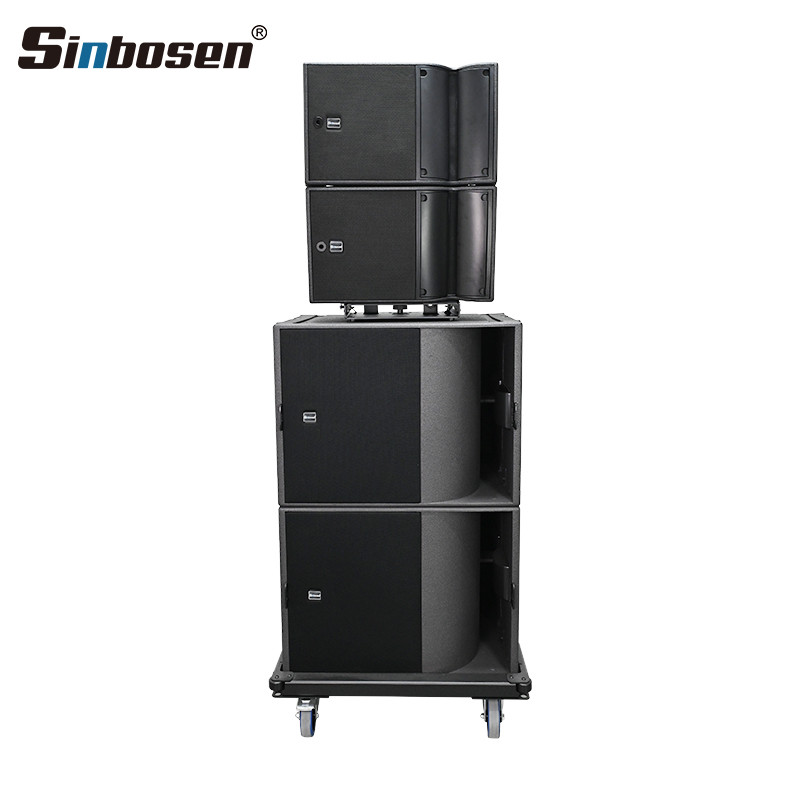
Option A’s key strength lies in its "tunable directivity." The KA10 series comes in two versions—Wide (with a 30° cabinet splay angle) and Focus (with a 10° splay angle). Combined with adjustable fins, the Wide version offers a 110° dispersion, ideal for covering round tables in broad, shallow banquet halls; the Focus version can be configured for 70° or 90° (asymmetric) dispersion to direct energy precisely toward the primary listening area. The Focus version is also designed for high-SPL, long-throw applications (up to ~35 meters), and both versions can be mixed within a single array to optimize SPL distribution. The system utilizes DSP-integrated amplifiers like the A-4X, which feature built-in preset libraries for crossovers, phase alignment, and limiting. Subwoofers are powered separately by high-current amplifiers (such as the DS-20Q)—a strategy mirrored in a Sinbosen wedding installation for 500 guests, where FP10000Q amplifiers drove the full-range speakers, while FP14000 units were dedicated to the subwoofers.
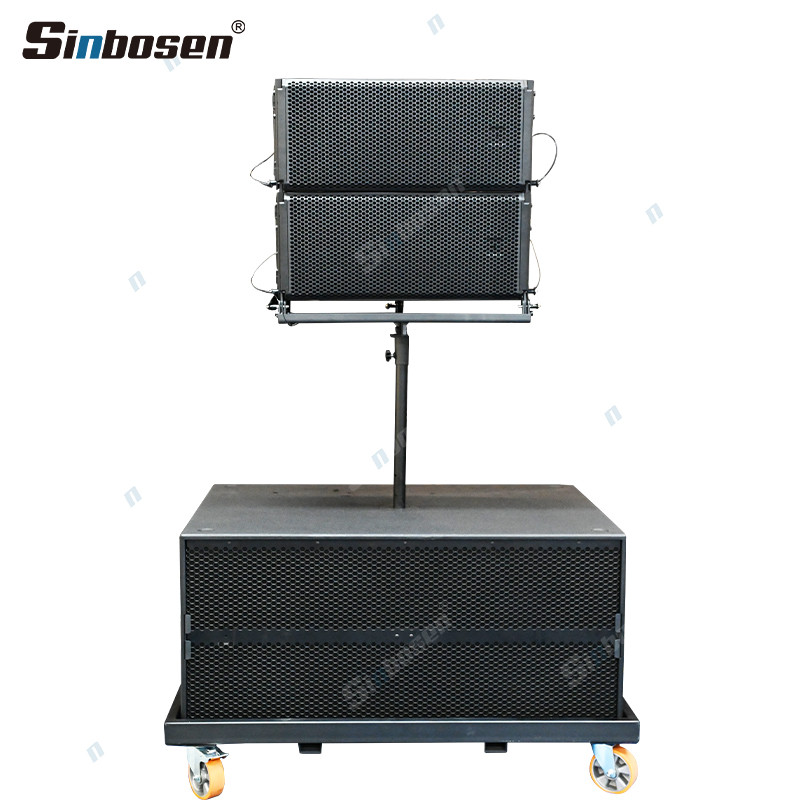
Option B focuses on "minimizing on-site labor." The A-9006S functions as an all-in-one unit, integrating a loudspeaker, amplifier, and DSP. The H-30A’s zero-phase DSP handles time-alignment for individual drivers within the array, preventing "dead zones"—areas where sound clarity might otherwise drop off when multiple cabinets are stacked. The rear panel of the 9006S includes controls for Low Cut (30/40 Hz), adjustable crossovers, delay, phase, and a switchable cardioid/omnidirectional pattern. The cardioid preset suppresses low-frequency energy behind the stage, which helps prevent feedback issues with the lavalier and handheld microphones used during ceremonies. Sinbosen offers two setup configurations for this combination: a pole-mounted setup (using a support pole to mount the line array atop the subwoofer, with the entire assembly placed on a caster-equipped base for easy, single-person mobility) and a ground-stacked configuration (which provides a lower center of gravity, making it well-suited for permanent installations).
Which option should you choose?
For most general needs, Option B (H-30A + 9006S) is the recommended choice. The vast majority of weddings with 500 guests are held in hotel banquet halls, where setup time is tight and a dedicated sound engineer is often unavailable. Active (self-powered) loudspeakers eliminate the need for rack wiring, complex patching, and manual gain-staging; in fact, the manufacturer explicitly identifies hotel banquet halls as suitable environments for pole-mounted deployments.
Option A should be chosen only under three specific circumstances: if there is a permanent technical team and equipment that will see frequent, long-term rotation; if the initial procurement budget is constrained or the setup is intended for a fixed installation; or if the venue’s layout—whether exceptionally wide, narrow/elongated, or obstructed by columns—requires the adjustable dispersion capabilities of the KA10 series for precise horizontal coverage tuning. The advantages of Option A include a lower cost per unit, the ability to replace individual cabinets if a channel fails, and the fact that all signal processing remains centralized in the equipment rack, under the direct control of the sound engineer.
A "plug-and-play" setup should include a 12–16 channel mixing console, a 4-channel wireless microphone system, a power sequencer, mounting hardware (such as rigging gear or speaker stands), all necessary cabling, flight cases, and rain covers—along with on-site setup and tuning. Items most frequently overlooked include custom-measured cable lengths based on the specific venue, power sequencing, and pre-configured DSP presets tailored for different segments of an event (ceremony, dinner, and party). For the ceremony, enable feedback suppression and use a cardioid polar pattern with tightened low-frequency response; for the dinner, utilize wide-dispersion patterns and delay-aligned fill speakers to ensure consistent coverage throughout the venue; for the party, allow for a fuller low-end, while ensuring the output limiters are set to provide a final layer of system protection. If you require such a setup, feel free to contact Sinbosen directly.
Frequently Asked Questions (FAQ)
Q: Are two pairs of large speakers enough? No. For an audience of 500, the limiting factors are reverberation, the sound pressure level (SPL) differential between the front and rear areas, and microphone gain-before-feedback—not just raw power. The entire system must be configured holistically.
Q: Which setup should I order?
The default choice is the H-30A + 9006S (a 4+4 configuration: 2+2 on each side). Opt for the KA10 + KA21 only if you have a dedicated, recurring crew, are working with a tight budget, or specifically need to adjust horizontal dispersion.
Q: Why is a 4+4 configuration with split left/right placement necessary?
You need at least two line-array elements per side to form a proper array, and two subwoofers per side to achieve a cardioid (directional) bass pattern. Splitting the system left and right reduces the maximum throw distance, which is better suited for wide, shallow venues (like those with round-table seating) compared to a centralized stack.
Q: If I choose active (self-powered) speakers, do I still need to include amplifiers and processors?
You don’t need separate amplifiers or standalone processors, but you must include power distribution circuits, daisy-chained power cables, and network cables in your equipment list.
Q: Do I need to change the configuration for outdoor events, venues with columns, or low ceilings?
Keep the hardware the same, but adjust the placement and dispersion: for outdoors, use IP55-rated/polyurea-coated cabinets with rain covers; for columns, add fill speakers with time-alignment; for low ceilings where flying (suspending) the array isn't possible, use pole-mounted stands with casters.
Q: Do I need different equipment for ceremonies, dinners, and parties?
No; simply save three distinct DSP configurations as presets that can be recalled instantly during on-site setup.
Q: What is most easily overlooked before arriving on-site?
Wireless frequency coordination (to prevent interference when multiple events are held simultaneously in a hotel), rigging point load capacities and cabinet splay angles, power distribution circuits and sequencing, subwoofer time-alignment and phase verification, and verifying that all three DSP presets have been correctly loaded and saved.