
What Are Active and Passive Speakers: A Comprehensive Comparison for Your Audio Needs
When diving into the world of professional audio, one of the most fundamental decisions you'll face is choosing between active and passive speakers. This choice is not merely a matter of preference; it is a crucial decision that will shape the functionality, portability, and scalability of your entire sound system. For anyone looking to invest in audio equipment, understanding the core differences between these two speaker types is the key to building a robust and effective PA system tailored to their specific audio needs.
Whether you're a gigging musician, a mobile DJ, a studio engineer, or setting up a permanent sound installation for a venue, the active versus passive debate is central to your setup. This guide will provide a comprehensive comparison, breaking down the technology, benefits, and considerations for each, empowering you to make an informed decision that perfectly aligns with your audio goals.
Active Speakers: The All-in-One Solution for Convenient Audio Needs
Active speakers, often referred to as powered speakers, are renowned for their integrated, all-in-one design. They represent a streamlined approach to sound reinforcement, packing amplification and signal processing directly into the speaker enclosure. This "plug-and-play" philosophy has made them an incredibly popular choice for a wide range of applications, particularly where convenience and rapid deployment are top priorities.
What Makes Them Active?
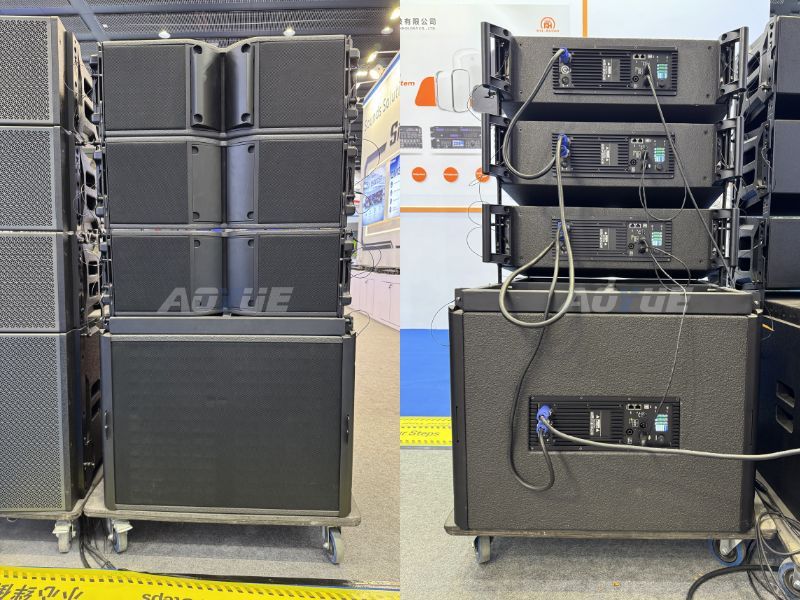
The defining characteristic of an active speaker is its onboard amplification. Unlike their passive counterparts, which require external power, active speakers have all the necessary components built right in to function as a standalone unit once a line-level signal is supplied.
Built-in Amplifier Simplifies Setup
At the heart of an active speaker is an integrated power amplifier. This means that unlike a passive speaker, which needs a separate, external amplifier to make sound, an active speaker just needs to be plugged into a power source and fed a line-level audio signal (from a mixer, audio interface, or even directly from a phone or laptop). This design philosophy drastically simplifies the audio signal chain. The journey of the sound is straightforward: the audio source sends a weak electrical signal to the active speaker, and the powerful amplifier built inside boosts that signal enough to move the speaker drivers and create sound.
A crucial component working alongside the amplifier is the active crossover. A crossover is an electronic filter that splits the audio signal into different frequency bands—lows, mids, and highs. In an active speaker, this crossover network operates on the signal before it reaches the amplifiers. It separates the frequencies and sends each band to its own dedicated amplifier channel, which then powers the corresponding driver (e.g., woofer for lows, tweeter for highs). This process is highly efficient because the amplifiers only work on the specific frequencies they need to, and it allows manufacturers to perfectly match the amplifiers and drivers for optimal performance. Many modern active speakers also include Digital Signal Processing (DSP), which offers advanced control over equalization, dynamics, and other sound characteristics.
Benefits: Easy Setup & Touring Ready
The primary advantage that draws users to active speakers is their unparalleled convenience and ease of use. The integration of amplifier and speaker into a single unit creates a system that is often described as "plug-and-play."
Integrated Design for Portability
For mobile DJs, touring musicians, and corporate event providers, active speakers are a game-changer. The entire sound system for a small to medium venue can consist of just two active main speakers and a mixer. This significantly reduces the amount of gear you need to transport, set up, and tear down. There are no heavy racks of amplifiers to carry, and cabling is simplified to just a power cable and a signal cable for each speaker.
This streamlined setup not only saves physical effort but also time. You don't have to worry about complex wiring or making sure your components are compatible. Because the manufacturer has already matched the amplifier to the speaker's drivers, you are guaranteed optimized and reliable performance right out of the box. This makes active speakers ideal for users who may not have deep technical knowledge of audio engineering but still need professional-quality sound. Many modern active systems are designed with portability in mind, featuring lightweight materials and compact designs that make them easy to carry and fit into a vehicle.
Considerations: Weight & Initial Investment
Despite their convenience, active speakers have a couple of trade-offs to consider. The most noticeable is the weight of each individual speaker unit. Because the amplifier, power supply, and often a heat sink are all housed within the speaker cabinet, active speakers are considerably heavier than their passive counterparts of the same size. For solo performers or those who have to lift speakers onto stands by themselves, this extra weight can be a significant factor.
Another point of consideration is maintenance and repair. If a component inside an active speaker fails—be it the amplifier, the power supply, or the driver—the entire unit is out of commission and typically needs to be sent to a specialist for repair. You can't simply swap out an external amplifier as you could in a passive system. Finally, while the total system cost might be competitive because you don't need to buy a separate amplifier, the initial per-unit cost of an active speaker is often higher than a single passive speaker.
Passive Speakers: Building a Flexible PA System for Your Audio Needs
Passive speakers represent the traditional, modular approach to sound reinforcement. They are the choice for those who want maximum control and flexibility over their sound system's components. A passive setup is a system of individual parts—speakers, amplifiers, crossovers, and processors—that you select and match to create a truly customized audio experience.
The External Amplifier Requirement
The fundamental principle of a passive speaker is that it does not have a built-in power source. It is, in essence, just a speaker cabinet containing the drivers (woofer, tweeter) and a passive crossover network. To produce sound, it must be connected to an external power amplifier via speaker cables.
Separate Amplifier Powers the System
The typical signal chain for a passive speaker setup looks like this:
- Audio Source: A mixer, controller, or other device outputs a line-level signal.
- Signal Processor (Optional): The signal may go through equalizers, compressors, or an external crossover.
- Power Amplifier: The line-level signal is fed into a power amplifier. The amplifier boosts the signal's power significantly.
- Passive Speaker: The high-power signal travels from the amplifier through heavy-gauge speaker cables to the passive speaker.
- Passive Crossover: Inside the speaker, a passive crossover network (made of capacitors, inductors, and resistors) splits the now-amplified signal and sends the appropriate frequencies to each driver.
This separation of components is the defining feature of a passive system.
Advantages: System Flexibility & Lighter Speaker Units
The modular nature of passive systems offers significant advantages, particularly in terms of flexibility and customization.
Ideal for Permanent Installations
One of the most compelling reasons to choose a passive system is the ability to upgrade individual components over time. You can start with a modest amplifier and speakers and later upgrade to a more powerful amplifier without needing to replace your speakers, or vice-versa. This modularity makes passive systems highly scalable and future-proof.
Passive speakers themselves are also lighter and often less expensive than their active counterparts since they don't contain heavy amplification components. This makes them easier to handle and mount, a major benefit for permanent installations in venues like churches, theaters, concert halls, and nightclubs. In these scenarios, all the amplifiers can be housed in a single, secure, climate-controlled rack room, with only speaker wire needing to be run to the various speaker locations throughout the venue. This centralizes and simplifies maintenance; if an amplifier channel fails, it can be quickly swapped out from the rack without needing to access a speaker that might be mounted high on a wall or flown from the ceiling.
Critical Match: Amplifier Power and Impedance
While the flexibility of a passive system is a major plus, it also comes with a significant responsibility: correctly matching your amplifier to your speakers. This is perhaps the most critical technical aspect of building a passive PA system, and getting it wrong can lead to poor performance and even damaged equipment.
Ensuring Optimal Performance and Safety
There are two key specifications to understand:
- Impedance (Ohms/Ω): This is the speaker's electrical resistance. Most PA speakers have a nominal impedance of 4, 8, or 16 ohms. Amplifiers are designed to operate safely into a specific impedance load. Running an amplifier into an impedance that is too low can cause it to overheat and shut down or fail permanently.
- Power Handling (Watts): This indicates how much power a speaker can handle before it gets damaged. It's often listed as "Continuous" (or RMS) power and "Peak" (or Program) power. Continuous power is the average power the speaker can handle over long periods, while peak power is the maximum it can handle for brief instants.
The Golden Rule of Matching: A common professional guideline is to choose an amplifier that can deliver approximately twice the continuous (RMS) power rating of your speaker at the speaker's nominal impedance. For example, if your speaker is rated at 500 watts continuous at 8 ohms, you should look for an amplifier that can output around 1000 watts into an 8-ohm load.
Why so much power? This extra power is called "headroom." It allows the amplifier to reproduce sudden, loud transients in the music (like a snare drum hit) without being pushed to its limits. When an amplifier is pushed too hard, it "clips," which means it tries to produce a voltage beyond its capability. This creates a distorted, square-like waveform that sends a large amount of high-frequency energy to the speaker's tweeter, which can quickly overheat and destroy it. Paradoxically, an underpowered amplifier driven into clipping is often more dangerous to a speaker than a more powerful, clean-running amplifier.
Here is a simplified table for understanding the relationship:
| Speaker Spec | Issue | Risk | Solution |
|---|---|---|---|
| Impedance Too Low | Connecting speakers in parallel lowers the total impedance. For example, two 8-ohm speakers in parallel present a 4-ohm load to the amp. | The amplifier tries to deliver more current than it's designed for, leading to overheating and potential failure. | Check the amplifier's minimum impedance rating. Use series wiring or a higher-impedance speaker if necessary. |
| Underpowering | Using an amp with too little power and turning it up too high to achieve the desired volume. | The amplifier goes into clipping, generating harmful distortion that can destroy tweeters. | Use an amplifier with enough headroom (1.5-2x the speaker's continuous power rating). |
| Overpowering | Sending far more power to the speaker than its continuous or peak rating allows. | Can cause mechanical damage (over-excursion of the woofer) or thermal damage (burning out the voice coil). | Use an amplifier that is appropriately sized and set system limiters to protect the speakers. |
Carefully reading the specifications for both the amplifier and speakers is non-negotiable for anyone building a passive system.
Active vs. Passive Speakers: A Head-to-Head Comparison
To make the choice clearer, here is a detailed breakdown of how active and passive speakers stack up against each other across several key categories.
| Feature | Active (Powered) Speakers | Passive (Unpowered) Speakers |
|---|---|---|
| Core Components | Amplifier, crossover, and drivers are all in one cabinet. | Speaker cabinet contains only drivers and a passive crossover. Requires an external amplifier. |
| Signal Chain | Source → Active Speaker | Source → Amplifier → Passive Speaker |
| Setup & Simplicity | Plug-and-play. Simpler and faster to set up with fewer cables. Ideal for beginners and quick deployment. | More complex. Requires matching amps to speakers and running speaker cables. More components to manage. |
| System Weight | Individual speaker units are heavier due to built-in amps. | Individual speaker units are lighter. Total system weight depends on the separate amplifier rack. |
| Portability | Excellent for mobile applications (DJs, bands) as it's a self-contained system. | Can be less portable due to separate amp racks, but individual speaker units are easier to lift and mount. |
| Flexibility & Upgradability | Low. Components are integrated. You cannot upgrade the amplifier or crossover without replacing the whole speaker. | High. You can upgrade or replace the amplifier, processor, or speakers independently. Highly customizable. |
| Best Use Case | Mobile DJs, touring musicians, corporate AV, small to medium-sized events, and users who prioritize convenience. | Permanent installations (churches, theaters, clubs), large-scale touring systems, and audiophiles who want to customize their setup. |
| Performance Control | Performance is pre-optimized by the manufacturer. Many models include DSP for fine-tuning. | Performance depends heavily on the user's ability to correctly match the amplifier and speakers. Offers ultimate control. |
| Maintenance | If one internal component fails, the entire speaker is out of action and requires specialized repair. | If an amplifier fails, it can be easily swapped out. Individual speaker components (drivers) can often be replaced. |
| Cost | Often a higher initial cost per speaker, but potentially lower total system cost for simple setups as no external amp is needed. | Lower cost per speaker, but the total system cost must include a suitable external amplifier, which can be expensive. |
Conclusion
In conclusion, the decision between active and passive speakers fundamentally boils down to a thorough understanding of your unique audio needs and the intended application of your PA system. There is no single "better" option; rather, each type offers distinct benefits that make it the superior choice for different scenarios. Both pathways can lead to building a comprehensive and highly effective sound setup.
Active speakers offer an elegant, all-in-one solution that champions simplicity, speed, and portability. They are perfect for those who need to set up and tear down quickly and demand reliable, manufacturer-optimized performance with minimal fuss. Conversely, passive speakers provide a world of flexibility, scalability, and granular control. They are the preferred choice for permanent installations and for audio professionals who seek to meticulously craft and customize their sound by mixing and matching individual components. We hope this comprehensive comparison has armed you with the critical insights needed to make a confident and informed decision for your next sound project. Feel free to share this guide with others, and let us know your choice in the comments below!
Frequently Asked Questions (FAQ)
Can you use active and passive speakers together in the same system?
Yes, it is possible to use active and passive speakers together, but not interchangeably. The key is to ensure each speaker type gets the correct signal and power. For instance, you could use a pair of active speakers for your main front-of-house sound and a separate amplifier powering passive speakers as stage monitors. The signal from the mixer would be split, with a line-level signal going to the active speakers and another line-level signal going to the power amplifier for the passive monitors. You cannot, however, power a passive speaker by plugging it into the output of an active speaker unless the active speaker is specifically designed with a powered output for this purpose, which is very rare.
Do active speakers still need a mixer?
While some active speakers have basic inputs and volume controls, allowing you to plug in a single microphone or instrument directly, a mixer is highly recommended for most practical applications. A mixer provides essential functions that a speaker alone does not, such as:
- Multiple Inputs: Connect several microphones, instruments, and playback devices simultaneously.
- Level Control: Properly balance the volume of all your sources.
- Equalization (EQ): Adjust the tonal balance (bass, mids, treble) for each channel to improve clarity and fix problematic frequencies.
- Signal Routing: Send audio to different destinations, such as main speakers, monitors, and recording devices. Many modern portable active column array systems now come with sophisticated multi-channel digital mixers built right into the base, offering a true all-in-one solution.
Are passive speakers better for home audio and hi-fi setups?
For many audiophiles and home theater enthusiasts, passive speakers are the preferred choice. The primary reason is the immense flexibility and potential for sonic excellence that comes with a component-based system. Enthusiasts enjoy the process of experimenting with different amplifiers, preamps, and DACs (Digital-to-Analog Converters) to find the perfect synergy and achieve a specific sound signature. This modularity allows for incremental upgrades over time, which is a core aspect of the hi-fi hobby. While high-quality active speakers for home use certainly exist and offer great convenience, the traditional path to high-fidelity audio often involves the careful selection and matching of separate, high-performance passive components.
How can I quickly tell if a speaker is active or passive?
The quickest way to identify a speaker is to look at its back panel.
- An active speaker will have a power cord connection (an IEC input, like a computer power cable) and usually a power switch. It will also have line-level inputs like XLR or 1/4-inch TRS jacks, and often volume and EQ control knobs.
- A passive speaker will have a much simpler back panel. It will not have a power cord connection. Instead, it will feature speaker-level inputs, which are typically either SpeakON connectors (a large, round, twist-locking connector) or binding posts/spring clips for bare speaker wire. There will be no volume or tone controls on the speaker itself.