
Understanding Passive and Active Line Array Speakers for Outdoor Concerts
As a sound professional, I understand the thrill and the immense challenges that come with delivering pristine, powerful audio for outdoor concerts. The open air is an unforgiving venue, and your reputation rests on the clarity and impact of every note that reaches the audience. Choosing the right sound system is paramount, and for large-scale events, the debate often comes down to two primary technologies: passive and active line array speakers. Each approach offers a distinct set of advantages and operational demands. Join me as we explore these powerful solutions, using the robust engineering of Sinbosen as our benchmark, to help you make the most informed decision for your next unforgettable outdoor event.
Key Takeaways: Active vs. Passive Line Arrays at a Glance
Before we delve into the technical specifics, let's establish a clear overview. The choice between active and passive line arrays isn't about which is definitively "better," but which is the right tool for a specific job. An active line array speaker integrates the amplifier directly into the speaker cabinet, creating a self-contained, powered unit. In contrast, a passive line array speaker is an unpowered cabinet that relies on external amplifiers to drive it. This fundamental difference dictates everything from setup speed and system complexity to scalability and maintenance.
Here’s a breakdown of the core considerations:
| Feature | Active Line Array Speakers | Passive Line Array Speakers |
|---|---|---|
| System Design | All-in-one units with built-in amplifiers and processing. | Component-based system with separate speakers, amplifiers, and DSPs. |
| Setup Speed | Faster and simpler. Requires signal and power cables for each speaker. | More complex and time-consuming. Involves rigging speakers, running speaker wire, and connecting amplifier racks. |
| Weight & Rigging | Individual speakers are heavier due to internal components. This can impact total weight limits on rigging points. | Individual speakers are lighter, but the total system weight includes hefty external amplifier racks. |
| Scalability | Good for small to medium events. Scaling up means running more power and signal lines, which can become complex. | Excellent for large to massive events. Systems are designed for easy expansion by adding more cabinets and amplifier channels. |
| Control & Tuning | Often feature built-in DSP with presets. Adjustments might need to be made on each speaker or small groups of speakers. | Centralized control via dedicated System Processor (DSP). Allows for global, granular control over the entire system from one location. |
| Maintenance | If an amplifier fails, the entire speaker unit must be brought down for repair, which is difficult mid-show. | If an amplifier channel fails, it can often be rerouted or the amp can be swapped out from the rack, with minimal disruption to the array. |
| Ideal Use Case | Mobile setups, corporate events, smaller festivals where speed and simplicity are key. | Large music festivals, stadium tours, and installations where maximum power, control, and scalability are required. |
Ultimately, active systems from a brand like Sinbosen excel in scenarios demanding convenience and rapid deployment for audiences of a moderate size. They are perfect for rental companies and event production teams that handle a variety of functions and need a "plug-and-play" solution that guarantees consistent, optimized performance. On the other hand, Sinbosen's passive line array systems are the weapons of choice for touring professionals and large-venue engineers who require the ultimate in power, flexibility, and granular control. The ability to design a massive, perfectly tuned system with centralized management and field serviceability makes it the industry standard for any event where compromise is not an option.
Active vs. Passive: Unpacking Sinbosen Line Array Speakers for Outdoor Settings
The debate between active and passive systems is at the heart of professional audio deployment. Both technologies aim to achieve the same goal—delivering clear, coherent sound over a large area—but they take different paths to get there. Understanding their core philosophies is the first step in mastering outdoor sound reinforcement.
Understanding Active Line Array Speakers
Active line array speakers, often called "powered" or "self-powered" systems, are the all-in-one solution in the world of professional audio. The defining characteristic is the integration of the amplifier directly into the speaker cabinet. This means each speaker unit in the array has its own dedicated power source and, in modern systems like those from Sinbosen, its own sophisticated Digital Signal Processor (DSP). This integration creates a self-contained unit that only needs a line-level audio signal and an AC power connection to operate.
Advantages of Active Systems:
- Optimized Performance: The manufacturer perfectly matches the internal amplifier's power and characteristics to the specific drivers (woofers, tweeters) in the cabinet. This factory-tuned synergy eliminates guesswork and ensures the components operate at peak efficiency and with minimal distortion.
- Simplified Setup: For mobile productions and events with tight schedules, the "plug-and-play" nature of active speakers is a massive advantage. It eliminates the need for heavy external amplifier racks and reduces long, thick speaker cable runs, simplifying cable management and speeding up deployment.
- Integrated DSP Control: Modern active speakers, such as those in Sinbosen's lineup, feature powerful onboard DSP. This "brain" allows engineers to precisely control parameters like equalization (EQ), crossover points, delay, and limiting for each individual speaker, often adjusted wirelessly from a laptop or tablet.
- Consistency: Because each speaker's amplification is self-contained, there is less signal degradation over long cable runs, leading to more consistent performance across the entire array.
Disadvantages to Consider:
- Weight and Rigging: Integrating an amplifier and heatsink into every cabinet makes each speaker heavier than its passive counterpart. This added weight must be carefully factored into the total load limits of the rigging structure, especially for large arrays.
- Power Distribution: While signal cabling is simpler, power management becomes more complex. Each active speaker in the hang needs its own AC power connection, which can mean running numerous power cables up to the array—a significant logistical challenge for large outdoor setups.
- Maintenance and Serviceability: In the event of an amplifier failure mid-show, the entire speaker cabinet must be taken down for repair or replacement. This is far more disruptive than swapping out a faulty channel on a ground-based amplifier rack.
Sinbosen's active line array solutions are engineered to maximize these benefits, providing a reliable, high-performance option for events where speed, simplicity, and consistent quality are the highest priorities.
The Fundamentals of Passive Line Array Speakers
Passive line array speakers represent the traditional, modular approach to large-scale sound reinforcement. The term "passive" signifies that the speaker cabinets themselves are unpowered. They contain the drivers (transducers) and an internal crossover network but rely on separate, external amplifiers for power. This component-based philosophy is the preferred choice for many of the world's largest tours and festivals for several key reasons.
A typical passive line array system consists of:
- Passive Speaker Cabinets: Individual, unpowered speaker enclosures designed to be rigged together.
- External Amplifier Racks: Racks of high-powered amplifiers that provide the electrical energy to drive the speakers.
- System Processor (DSP): A dedicated digital signal processor that manages crossovers, equalization, limiting, and time alignment for the entire system, usually located with the amplifiers.
- Speaker Cabling: Heavy-gauge cables to run from the amplifier racks to the speaker arrays, which can be a considerable distance in a large venue.
Advantages of Passive Systems:
- Scalability and Flexibility: Passive systems are exceptionally scalable. An engineer can easily add more speaker cabinets to an array and simply connect them to available amplifier channels. This modularity allows for greater customization in system design, as engineers can mix and match high-end amplifiers and DSPs to achieve their desired performance.
- Easier Serviceability: A major advantage for large tours is the ease of maintenance. If an amplifier fails, it is located on the ground in a rack and can be quickly swapped out, often without the show-stopping drama of having to lower a 2,000-pound speaker array.
- Lighter Speaker Cabinets: Without the weight of internal amps and heatsinks, individual passive speakers are significantly lighter. This can be a critical factor when dealing with venue rigging points that have strict weight limits, sometimes allowing for more speaker elements to be flown.
- Centralized Control: The entire sound system can be controlled and monitored from a single location (the amplifier village). This allows a system engineer to make global adjustments to the entire PA without having to access individual speakers.
Disadvantages to Consider:
- Increased Complexity: Setting up a passive system is more labor-intensive. It requires connecting heavy amplifier racks, running extensive speaker cabling, and carefully configuring the external DSP.
- Potential for Mismatches: The performance of the system is highly dependent on the proper matching of amplifiers to speakers. An improper match can lead to poor sound quality or even damage to the components.
- Heavy Amplifier Racks: While the speakers are lighter, the overall system includes extremely heavy amplifier racks that require significant space and effort to transport and position.
For large-scale outdoor concerts, a brand like Sinbosen's passive line array offerings provide the power, control, and scalability necessary to deliver sound to tens of thousands of people with precision and reliability.
Amplifier Matching for Passive Systems
One of the most critical skills when deploying a passive line array system is correctly matching the external amplifiers to the speakers. This isn't just about making sound; it's about achieving optimal performance, clarity, and system longevity. An improper match can lead to underperformance, distortion, or even catastrophic failure of your expensive equipment. Several key factors must be considered:
Key Matching Concepts
- Impedance (Ohms): Impedance is the electrical resistance of the speaker to the amplifier's signal. It's crucial that the amplifier can safely handle the speaker's nominal impedance (typically 4, 8, or 16 ohms). Mismatching impedance can lead to the amplifier overheating and failing. When you connect multiple speakers in parallel to a single amplifier channel, the total impedance drops. For example, two 8-ohm speakers in parallel present a 4-ohm load to the amplifier. You must ensure your amplifier is rated to be stable at that lower impedance.
- Power Handling (Watts): Speakers have a continuous power rating (often called RMS), which is the amount of power they can handle over a sustained period. A common professional rule of thumb is to choose an amplifier that can deliver 1.5 to 2 times the speaker's continuous power rating. This extra power is known as headroom.
- Headroom: Headroom is the difference between the normal operating level of the amplifier and its maximum, undistorted output level. Music is dynamic, with loud peaks (like a snare drum hit) that can be 10-20 dB higher than the average level. An amplifier with sufficient headroom can reproduce these short, powerful transients cleanly without clipping. If an underpowered amplifier is driven too hard to achieve the desired volume, it can enter "clipping," sending a distorted square wave signal that can quickly destroy a speaker's voice coil.
- Damping Factor: Damping factor is a measure of an amplifier's ability to control the movement of the speaker cone, especially at low frequencies. A higher damping factor generally means the amplifier has better control, resulting in tighter, more defined bass. It describes the amplifier's ability to "brake" the speaker cone's tendency to keep moving after a signal has stopped. This is crucial for preventing a "muddy" or "boomy" low-end response.
Matching Sinbosen Amplifiers to Passive Line Arrays
Let's illustrate with a practical example using Sinbosen components. Imagine you have a passive line array cabinet with the following specifications:
- Continuous Power Rating: 500 Watts
- Nominal Impedance: 8 Ohms
Following the professional standard, you'd look for an amplifier that provides headroom.
Amplifier Power Calculation:
Speaker Continuous Power x 1.5-2.0 = Ideal Amplifier Power
500 Watts x 1.5 = 750 Watts
500 Watts x 2.0 = 1000 Watts
So, for one speaker, you need an amplifier channel that can deliver between 750 and 1000 Watts at 8 Ohms.
| Number of Speakers (in parallel) | Total Load Impedance | Ideal Amplifier Power (per channel) | Example Sinbosen Amplifier Model |
|---|---|---|---|
| 1 Cabinet | 8 Ω | 750-1000W @ 8Ω | Sinbosen FP10000Q |
| 2 Cabinets | 4 Ω | 1500-2000W @ 4Ω | Sinbosen FP14000 |
| 3 Cabinets | ~2.7 Ω | 2250-3000W @ 2.7Ω | Sinbosen FP20000Q (2-ohm stable) |
| 4 Cabinets | 2 Ω | 3000-4000W @ 2Ω | Sinbosen FP22000Q (2-ohm stable) |
Note: This table is for illustrative purposes. Always consult the specific datasheets for both your Sinbosen speakers and amplifiers to ensure perfect compatibility.
Properly matching your Sinbosen amplifier not only safeguards your investment but also unlocks the full sonic potential of your passive line array system, ensuring every outdoor concert you produce is powerful, clear, and impactful.
Designing and Deploying Sinbosen Line Array Speakers for Outdoor Concerts
Beyond choosing between active and passive, the success of your outdoor concert sound hinges on meticulous design and deployment. The open-air environment lacks the predictable acoustics of an indoor venue, introducing variables like wind, temperature, and humidity that can drastically affect sound propagation. A well-designed Sinbosen line array system anticipates these challenges.
Strategic Sizing and Placement of Your Line Array
"Sizing" a line array involves more than just picking a model; it's about determining the number of speaker cabinets and the angles between them to perfectly cover the audience area. "Placement" refers to the height and horizontal position of the arrays. Getting these two elements right is the foundation of exceptional outdoor sound.
Determining Array Size: The length of the array (number of cabinets) directly impacts its vertical coverage and throw distance. A longer array provides more control over the sound dispersion and can project sound further with greater clarity. Key factors influencing the required size include:
- Audience Area: The depth and width of the crowd.
- Desired Sound Pressure Level (SPL): Rock concerts require higher SPL than a spoken-word event.
- Throw Distance: How far the sound needs to travel to reach the last row.
The J-Curve Configuration: For most concert applications, a "J-curve" or "J-shaped" array is used. The top portion of the array remains relatively straight, with very small angles (0-2 degrees) between cabinets. This straight section focuses energy for a long throw to cover the back of the audience. The bottom portion of the array is curved more dramatically, with larger angles (5-10 degrees) between cabinets to cover the listeners closer to the stage. This prevents deafening the front rows while ensuring the back rows receive clear audio.
Placement and Height: Height is your friend in outdoor audio. Flying the arrays high above the stage has two major benefits:
- It helps the sound travel over the heads of the front audience members to reach the back.
- It minimizes the difference in distance (and therefore volume) between the front and back rows.
Using Prediction Software: Modern system design relies heavily on acoustic prediction software like EASE Focus. This software allows engineers to build a virtual 3D model of the venue and audience areas. By inputting the specifics of the Sinbosen line array cabinets, the software can simulate the coverage, SPL, and frequency response throughout the audience. It helps determine the optimal number of boxes, the precise splay angles for the J-curve, and the ideal trim height before a single speaker is ever flown, saving immense time and ensuring predictable results.
By strategically combining array size, placement height, and the J-curve shape—all validated with prediction software—you can design a Sinbosen line array system that delivers consistent, powerful, and intelligible sound to every single person in the audience.
Ensuring Stability and Electrical Safety Outdoors
Deploying thousands of pounds of audio equipment high in the air requires an uncompromising commitment to safety. Outdoor concerts add layers of complexity, with wind, rain, and uneven ground all posing significant risks. Ensuring both the structural stability of the line array and the electrical safety of the entire system is a non-negotiable part of any professional production.
Structural Stability and Rigging
- Professional Rigging is Mandatory: Suspending a line array is a job exclusively for certified and licensed riggers. They understand load calculations, structural engineering principles, and the specific hardware required for safe overhead suspension. Never attempt a "do-it-yourself" rigging job, as a failure can be catastrophic. The building or stage structure itself must be evaluated by a structural engineer to confirm its capacity to support the load.
- Wind Loading: Wind is a primary hazard for outdoor shows. A large, flown line array can act like a sail, and a strong gust of wind can exert immense dynamic force on the rigging and support structure. The system designer must account for foreseeable wind loading and have a weather action plan in place, which may include lowering or securing the arrays if wind speeds exceed a specified limit.
- Rated Hardware: All components used for suspension—shackles, motor hoists, truss, and slings—must be professionally rated for overhead lifting with a clear Working Load Limit (WLL). Hardware must be inspected for wear, corrosion, or damage before every use. A secondary safety, like a steel cable, must also be attached as a backup.
- Ground Stacking: If flying the array isn't possible, it can be stacked on the stage or on dedicated subwoofers. It is crucial to ensure the ground is perfectly level and stable. Angled or uneven surfaces can cause the stack to become unstable and tip over. Stacked systems must also be securely strapped to prevent shifting or toppling from vibration.
Electrical Safety
- Weatherproof Equipment: All electrical components used outdoors, from extension cords to power distribution units, must be specifically rated for outdoor use. This ensures they can withstand exposure to moisture and temperature changes. While many professional speakers from brands like Sinbosen have weather-resistant features, it's still best practice to protect them with covers when not in use or during heavy downpours.
- Ground Fault Circuit Interrupters (GFCIs): GFCIs are essential safety devices for any outdoor event. They monitor the flow of electricity and will instantly cut power if they detect a ground fault (e.g., electricity flowing through water or a person), which can prevent a severe electric shock. All temporary outdoor power sources should be protected by GFCIs.
- Proper Grounding: A correctly grounded sound system is vital not only for safety but also for preventing audible hum and noise. Poor grounding can leave metal components like stage trusses or railings energized in a fault condition, creating a severe shock hazard. All system components should be connected to a common, well-established ground point.
- Cable Management: With hundreds of feet of cabling required for a large concert, tidy management is a safety imperative. Cables running through public or high-traffic areas should be secured and covered with heavy-duty cable ramps or protectors to prevent trip hazards and protect the cables from damage.
By prioritizing both structural and electrical safety protocols, you ensure the well-being of the audience, the crew, and the performers, allowing everyone to focus on the power of the music.
Optimizing Sound: Tuning Your Outdoor Line Array Speakers
Once your Sinbosen line array is safely and strategically deployed, the final, crucial step is tuning. This is where art meets science, transforming a collection of individual speakers into a single, coherent, and musical sound source. Tuning is a meticulous process of measurement and adjustment to compensate for the specifics of the rig and the challenges of the outdoor environment.
The process is typically iterative: Measure, Adjust, Repeat.
Essential Tools for Tuning
- Measurement Microphones: These are special microphones with an exceptionally flat frequency response, designed to capture what the sound system is actually doing in the space, free of coloration. Multiple mics are placed at strategic locations throughout the audience area (e.g., front, middle, back, and off-axis).
- Audio Analysis Software: The industry standard for real-time analysis is Smaart (System Measurement Acoustic Analysis Real-time Tool). Smaart compares the signal sent to the speakers with the signal captured by the measurement microphones, providing detailed visual data on frequency response, phase, and time alignment.
- Digital Signal Processor (DSP): The DSP is where the adjustments are made. It provides the tools for equalization, delay, and crossover management.
The Tuning Process
Time Alignment: This is the first and most critical step. Sound travels at a finite speed, so the sound from different parts of the system (e.g., the main line arrays and the ground-stacked subwoofers) will arrive at a listener's ears at different times. Time alignment involves using the DSP to add a small electronic delay to the closer speakers so that their wavefronts arrive at the primary listening positions at the exact same moment as the wavefronts from the farther speakers. Misalignment, even by a few milliseconds, can cause destructive interference (phase cancellation), resulting in audible dips in the frequency response, especially in the crucial crossover region between the mains and subs.
Phase Alignment: Phase goes hand-in-hand with time alignment. When the main arrays and subwoofers are properly phase-aligned at the crossover frequency, they work together constructively, creating a seamless and impactful low-end. Misaligned phase results in cancellation, making the bass sound weak or disconnected. An engineer uses software like Smaart to view the phase relationship between the subs and mains and adjusts delay and polarity to make them match as closely as possible.
Equalization (EQ): Once the system is time and phase coherent, equalization can be applied. The goal of EQ is not to "sweeten" the mix, but to correct for anomalies in the speaker system itself and its interaction with the environment, aiming for a consistent tonal balance across the entire audience area. This is a subtractive process; engineers identify and gently cut frequencies that are overly prominent, rather than boosting deficient ones. Walking the venue and comparing measurements from multiple microphones helps create an EQ curve that translates well to the entire space, not just one "sweet spot".
Environmental Compensation
The outdoor environment is constantly changing, and a good system engineer must be ready to adapt.
- Temperature and Humidity: Air temperature and humidity significantly affect the absorption of high frequencies. Drier air absorbs more HF energy than humid air. This means a system tuned in the humid afternoon may sound noticeably duller in the dry evening air as the temperature drops. The engineer must monitor these conditions and make subtle EQ adjustments to compensate for this HF loss.
- Wind: Wind can be a major disruptor. It can physically bend the path of sound waves, causing phasing issues and inconsistent coverage over long distances. A downwind audience might hear the show clearly, while an upwind audience experiences significant dropouts. While not something that can be fixed with EQ, awareness of wind direction can inform decisions about system level and the use of delay towers.
By meticulously applying these tuning techniques with professional tools, an engineer can optimize a Sinbosen line array system to overcome environmental challenges and deliver a powerful, clear, and consistent audio experience for every seat in the house.
Choosing the Right Sinbosen Line Array Speakers: Practical Applications for Outdoor Events
The choice between an active and a passive Sinbosen line array is not abstract; it's a practical decision driven by the specific demands of your event. The scale, budget, crew size, and turnaround time all play a role in determining which system is the most effective tool for the job.
Active Speakers for Convenience and Smaller Events
The "plug-and-play" ethos of active line array speakers makes them the superior choice for scenarios where speed, simplicity, and reliability are the top priorities. Because the amplifier and DSP are built-in and factory-optimized, you eliminate many of the setup complexities and variables associated with passive systems. This makes them ideal for rental companies and event teams that need to deploy quality sound quickly with minimal fuss.
Ideal Scenarios for Active Sinbosen Line Arrays:
- Mobile DJ Setups and Small Bands: For a mobile DJ or a band playing local festivals, the all-in-one nature of active speakers is a huge benefit. Transporting and setting up is vastly simplified when you don't need to haul around separate, heavy amplifier racks. You can carry less gear and achieve a faster, more streamlined setup.
- Small to Medium-Sized Outdoor Festivals: For community festivals, street fairs, or smaller music events with audiences of a few hundred to a couple of thousand, active line arrays provide more than enough power and coverage. The ability to quickly rig a few cabinets per side makes for an efficient deployment.
- Corporate and Public Speaking Events: In outdoor corporate settings or public rallies, spoken word intelligibility is key. Active speakers with built-in DSP offer presets optimized for speech, ensuring every word is heard clearly. Their fast setup is perfect for events with tight schedules.
- Productions with Limited Technical Crew: Because active systems eliminate the need for amplifier matching and complex DSP configuration, they are more forgiving for teams with less specialized technical expertise. This guarantees a consistent, high-quality result without requiring a dedicated system engineer.
In essence, a Sinbosen active line array system is the perfect workhorse for any application where convenience is a major factor. They provide professional-grade sound without the steep learning curve or logistical challenges of a large-format passive rig, making them an invaluable and versatile tool for a wide range of outdoor events.
Passive Speakers for Power and Scalability in Large Venues
When raw power, ultimate control, and massive scalability are the objectives, passive line array systems are the undisputed champions. This modular approach is the backbone of nearly every major international concert tour, stadium show, and large-scale music festival for compelling reasons that center on performance and logistics.
Ideal Scenarios for Passive Sinbosen Line Arrays:
- Large Music Festivals and Stadium Concerts: For events with audiences numbering in the tens or even hundreds of thousands, there is no substitute for the power and scalability of a large-format passive system. Engineers can fly extensive arrays—often 16 to 24 cabinets per side, plus delay towers—and power them from a centralized "amp city" on the ground. A passive approach makes it far more economical and practical to scale up a system to this magnitude.
- Venues with Strict Rigging Weight Limits: While counterintuitive, a passive system can sometimes be the solution for venues with limited weight capacity on their rigging points. Because individual passive speaker boxes are lighter without internal amplifiers, it may be possible to hang more cabinets to achieve the necessary vertical coverage, while the heavy amplifiers remain safely on the ground.
- Tours with Experienced Audio Crews: Professional touring crews with dedicated system engineers thrive on the flexibility of passive systems. They can choose their preferred high-end amplifiers and DSP for maximum performance and have full, granular control over every aspect of the system's tuning from a central location.
- Fixed Installations: For permanent installations in large venues like arenas, amphitheaters, or megachurches, passive systems are often the logical choice. They allow for a clean installation with lighter speaker arrays, while all the amplification and processing can be housed in dedicated, climate-controlled rack rooms for easy access and maintenance. A faulty amplifier can be serviced without disrupting the speaker installation high above.
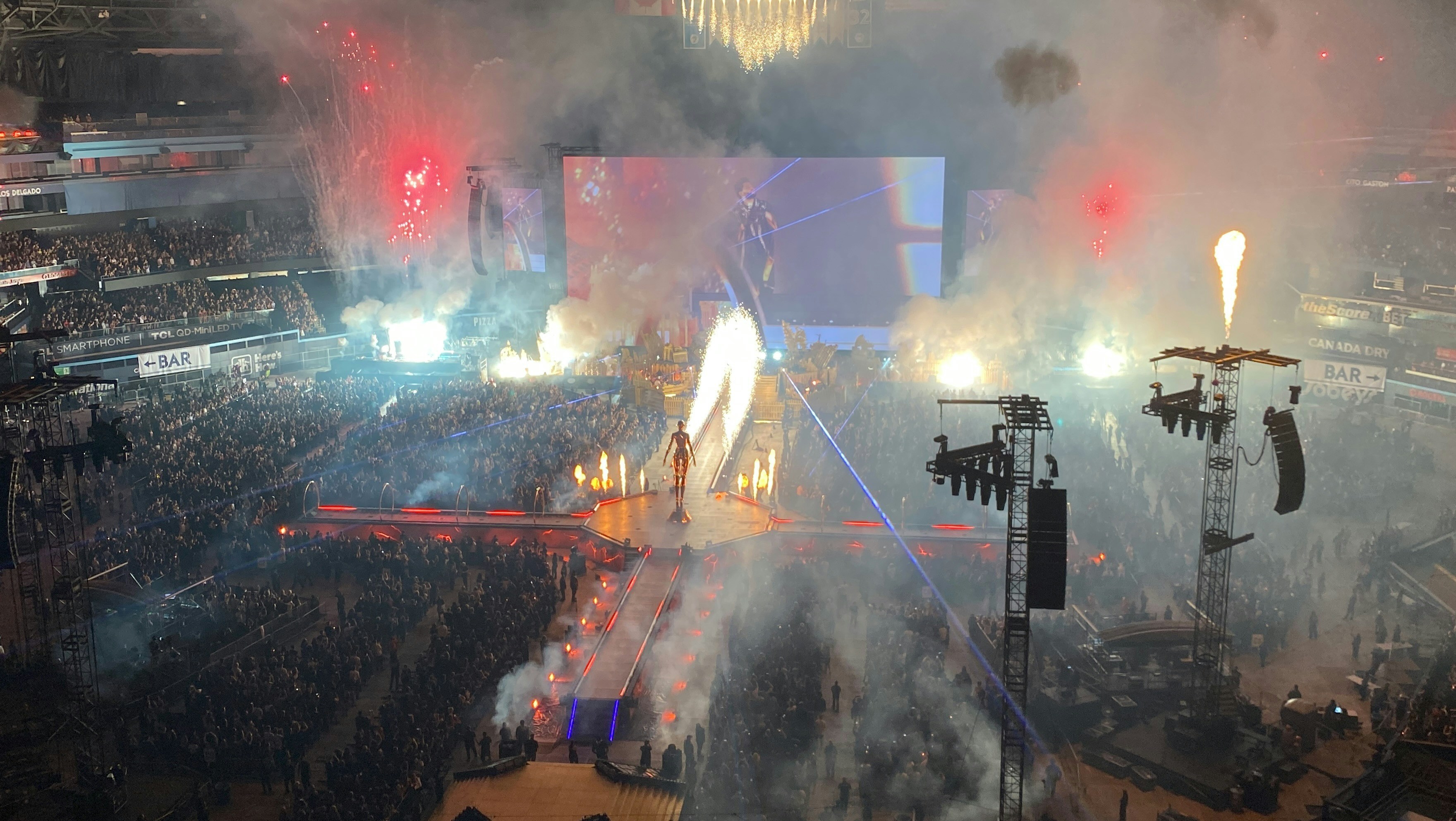
In these demanding environments, a passive Sinbosen line array system, paired with their robust power amplifiers and processors, provides the horsepower and refined control needed to deliver an epic and unforgettable audio experience on the grandest scale.
Enhancing Bass with Subwoofers for Line Array Speakers
While a full-range line array provides excellent clarity and throw for mid and high frequencies, it cannot reproduce the deep, physical impact that modern music demands. For a truly full-spectrum audio experience at an outdoor concert, dedicated subwoofers are not just an add-on; they are an essential component of the system. Properly integrating them with your Sinbosen line arrays is a critical step in system design.
The Crucial Role of the Crossover
The integration of subwoofers and line arrays is managed by the system's crossover. A crossover is an electronic filter that splits the audio signal into different frequency bands, sending the high and mid frequencies to the line array cabinets and the low frequencies to the subwoofers. A common crossover point for large-format systems is between 80 Hz and 100 Hz. Using a steep filter slope, like a 24 dB/octave Linkwitz-Riley filter, creates a sharp division that minimizes the frequency overlap between the two systems, which is vital for preventing phase issues.
Subwoofer Deployment Strategies
The physical placement of your subwoofers dramatically affects their performance and coverage.
- Ground-Stacked Subwoofers: This is the most common configuration, where subwoofers are stacked on the ground in front of the stage. This placement takes advantage of "ground coupling," where the reflection from the ground can increase the efficiency and perceived loudness of the bass by up to 3-6 dB. The main drawback is that the bass can be overwhelmingly loud for the front rows and significantly quieter at the back of the audience.
- Flown Subwoofers: For more even bass coverage across a large audience area, subwoofers can be flown (hung) along with or just behind the main line arrays. While this provides much more consistent low-frequency distribution from front to back, it can sometimes reduce the tactile, "punch-in-the-chest" feeling of ground-stacked subs. It also requires careful time alignment with the main arrays to ensure the sound from both arrives at the listeners' ears coherently.
- Cardioid Subwoofer Arrays: Low-frequency sound waves are omnidirectional, meaning they radiate equally in all directions. This causes a massive buildup of bass on stage, which can muddy the monitor mixes for performers and create feedback issues. A cardioid array is an advanced configuration designed to solve this problem. It uses a combination of forward-facing and rear-facing subwoofers with specific spacing and signal delay. The inverted signal from the rear-facing subwoofer cancels out the sound wave behind the array while reinforcing it to the front. This creates a heart-shaped (cardioid) dispersion pattern that focuses bass energy on the audience and can reduce rearward SPL by 15 dB or more, resulting in a much cleaner stage and a more impactful audience experience.
By carefully selecting a crossover point and deploying your Sinbosen subwoofers in a strategic configuration—whether ground-stacked for maximum impact or in a cardioid array for maximum control—you can deliver the powerful, full-bodied bass that brings an outdoor concert to life.
Frequently Asked Questions (FAQ)
Can I mix active and passive speakers in the same system?
While it's technically possible, it's generally not recommended for a main PA system, especially for beginners. The primary challenge lies in matching the gain structure, latency, and phase characteristics between the two different system types. Active speakers have their own processing and amplification, which introduces a certain amount of latency. Passive systems have their latency determined by the external DSP and amplifiers. Aligning these two disparate systems can be complex and requires advanced measurement tools and expertise to do correctly. A more common and practical approach is to use an active system for main hangs and possibly use smaller, separate active speakers for front fills or delays, as they can be timed and tuned independently. For a cohesive main line array, sticking to either all-active or all-passive is the best practice for predictable and consistent results.
How does weather affect line array performance outdoors?
Weather is one of the biggest variables in outdoor sound.
- Wind: Wind creates a gradient in the speed of sound, causing sound waves to "bend." Sound traveling downwind is bent downwards toward the audience, while sound traveling upwind is bent upwards, away from the audience. This can cause significant coverage variations.
- Temperature: Temperature gradients have a similar effect. On a sunny day, the air near the warm ground is hotter than the air above it, causing sound to refract upwards. At night, as the ground cools, this can reverse into a temperature inversion, where sound is bent back down towards the ground, sometimes allowing it to travel much farther.
- Humidity: The amount of water vapor in the air affects the absorption of high frequencies. Dry air absorbs more high-frequency energy than humid air. This means a system tuned in the afternoon might sound duller as humidity drops in the evening, requiring EQ adjustments to compensate.
- Rain: While light rain has a negligible effect on sound propagation itself, it poses a significant risk to the equipment. It's crucial to use weather-resistant speakers (like many Sinbosen models with polyurea paint and protective grilles) and ensure all electrical connections are weatherproofed and covered.
What is a 'J-curve' and why is it important?
A 'J-curve' refers to the physical shape of a modern line array hang. The top section of the array is kept relatively straight, with minimal angles (0-2°) between speaker cabinets. This portion of the array couples together to create a long, narrow beam of sound to cover the back of the audience. The bottom section of the array is curved more aggressively, with larger splay angles (e.g., 5-10°) between cabinets. This curved part provides broader vertical dispersion to cover the audience members closer to the stage. This 'J' shape is critical because it allows a single array to provide even volume and tonal coverage from the front row to the very back, avoiding the issue of deafening the front while the back struggles to hear.
How many line array speakers do I need for an event of 5000 people?
This is a classic "it depends" question. There's no simple formula, as the answer is influenced by several factors:
- Venue Geometry: How wide and deep is the audience area? A long, narrow field requires a different approach than a wide, shallow one.
- Desired SPL: Is this a loud rock concert or a more subdued jazz festival? The required loudness (measured in dB) dictates the necessary power and number of speakers.
- Type of Music: Dynamic, bass-heavy music requires more headroom and low-frequency capability than a speaking event.
- Environmental Noise: An event in a quiet park needs less power than one next to a busy highway. As a very rough starting point for an outdoor rock show, you might consider arrays of 8 to 12 dual-12-inch cabinets per side and a substantial subwoofer deployment. However, the only way to know for sure is to use acoustic prediction software like EASE Focus. An engineer will model the venue and use the software to determine the exact number of cabinets and angles needed to achieve the target SPL and coverage for all 5000 people.
Is a more expensive line array always better?
Not necessarily. While high-end systems from reputable brands like Sinbosen generally offer superior components, better build quality, more advanced DSP, and more predictable performance, the "best" system is the one that is most appropriate for the job. Using a massive, top-of-the-line passive touring rig for a small corporate event of 300 people would be overkill—logistically difficult, expensive, and potentially sonically inferior to a smaller, well-deployed active system designed for that scale. The best results come from choosing the right tool for the application and deploying it correctly. Expertise in system design and tuning is often more valuable than simply having the most expensive boxes.
What is the role of a DSP in a line array system?
The DSP, or Digital Signal Processor, is the brain of a modern sound system. In an active speaker, it's built-in; in a passive system, it's an external rack-mounted unit. The DSP performs several critical functions:
- Crossovers: It splits the audio signal, sending low frequencies to subwoofers and mid/high frequencies to the main line array cabinets.
- Equalization (EQ): It allows engineers to shape the tonal balance of the system, correcting for anomalies and ensuring consistent sound across the venue.
- Time Alignment (Delay): It applies microscopic delays to different speakers to ensure their sound waves arrive at the listener in perfect sync, which is essential for phase coherence and clarity.
- Limiting: It acts as a safety system, preventing the amplifiers from being overdriven into clipping, which protects the speakers from damage.
- System Voicing: Manufacturers use DSP to fine-tune the intrinsic sound of their speakers, correcting for any inherent imperfections in the drivers or cabinet design.
Without a powerful DSP, the precise control needed to make a line array perform correctly in a large-scale environment would be impossible.
Conclusion
Ultimately, choosing between passive and active Sinbosen line array speakers hinges on your specific event needs, budget, and the scale of your outdoor concert. Active systems offer unparalleled convenience and speed, making them the workhorse for smaller festivals, corporate events, and mobile gigs. Passive systems, in contrast, provide the immense power, granular control, and scalability required for the largest stadium tours and music festivals, where compromise is not an option.
By understanding their distinct characteristics—from amplifier matching and DSP control to rigging safety and deployment strategies—you are now well-equipped to make an informed and confident decision. The goal is always to deliver a flawless audio experience, and the right technology is the foundation of that success. With a trusted and engineered solution from a brand like Sinbosen, you can ensure your audience experiences powerful, clear, and unparalleled sound quality at any outdoor venue.
We hope this deep dive has been valuable! If you have experience with either system, share your thoughts in the comments below. Don't forget to share this article with other audio professionals in your network