

Understanding Power Supply Units for Professional Stage Power Amplifiers
As an audio enthusiast and professional, I've learned that the power supply unit (PSU) is often the unsung hero of any professional stage power amplifier. It's not just about delivering power; it's about delivering stable, clean, and reliable power that directly impacts the amplifier's performance, sound quality, and safety. Neglecting the PSU's importance in a professional stage power amplifier setup can lead to diminished sound quality, unreliable operation, and even equipment damage. In this blog, I'll walk you through the critical aspects of PSUs for professional stage power amplifiers, offering insights into their function, selection, and troubleshooting.
A professional power amplifier is an electronic device designed to increase the amplitude of audio signals, making them powerful enough to drive speakers and deliver crisp, clear sound without distortion. The PSU is the foundation upon which this entire process is built.
Key Takeaways
- The PSU is the Heart of the Amplifier: The power supply unit is not merely a component but the foundational element of a professional stage power amplifier. Its primary role is to convert AC power from the mains into the stable DC voltage required by the amplifier's circuitry. This process is critical for ensuring the amplifier can perform its core function of boosting audio signals effectively and reliably. The quality of this power directly dictates the amplifier's overall performance, from sound fidelity to its operational lifespan.
- Audio Quality is Directly Linked to PSU Quality: A high-quality PSU delivers clean, stable, and low-noise power, which is essential for pristine audio reproduction. A robust power supply provides the necessary "dynamic headroom," allowing the amplifier to handle sudden, high-energy musical peaks without clipping or distortion. Conversely, a subpar PSU can introduce unwanted noise like hum and buzz, and its inability to supply consistent power can lead to a compressed, lifeless sound and noticeable distortion, especially at high volumes.
- Selection Requires Careful Matching: Choosing the right PSU is a technical decision that involves matching several key specifications to the amplifier's requirements. This includes ensuring the voltage and current outputs meet the amplifier's demands, that the power rating (in watts) provides enough overhead for peak consumption, and that the PSU exhibits low ripple and noise. Furthermore, critical protection features like overcurrent (OCP), overvoltage (OVP), and over-temperature (OTP) protection are non-negotiable for safeguarding the amplifier and connected speakers from damage.
- PSU Type Matters: There are two main types of power supplies used in amplifiers: linear and switching (SMPS). Linear PSUs are known for their simplicity and low-noise output but are heavy, inefficient, and generate significant heat. Switching PSUs are much more efficient, lightweight, and compact, making them ideal for modern, high-power touring amplifiers. While older SMPS designs were sometimes criticized for introducing high-frequency noise, modern advancements have largely mitigated these issues, making them the standard in professional audio.
- Troubleshooting Often Leads to the PSU: Many common amplifier problems, such as failure to power on, intermittent shutdowns, audible hum or buzz, and poor audio quality at high volumes, can be traced back to the power supply. Overheating is another major symptom, often caused by an inefficient or underpowered PSU struggling to meet the amplifier's demands. Understanding how to diagnose these issues can save significant time and prevent further equipment damage.
- Investing in Quality is a Long-Term Strategy: Skimping on the power supply is a false economy. A high-quality, well-matched PSU not only ensures the best possible audio performance from your professional stage power amplifier but also enhances its reliability and longevity. It's an investment in consistency, safety, and the quality of the sound you deliver to your audience.
The Indispensable Role of PSUs in Professional Stage Power Amplifiers
At its core, a professional power amplifier takes a low-power audio signal and boosts it to a level sufficient to drive loudspeakers. This task seems straightforward, but achieving it with clarity, power, and reliability in a demanding stage environment falls squarely on the shoulders of the power supply unit (PSU). The PSU is the engine of the amplifier. Many audiophiles argue that when you listen to a power amplifier, you are essentially listening to the sound of its power supply being modulated by the audio signal. It's the true source of the amplified power, with the amplifier's circuits acting as a complex valve that shapes the energy provided by the PSU. Without a robust and stable power supply, even the most sophisticated amplifier design is rendered ineffective.
Converting and Delivering Power
The Core Function of a PSU
The fundamental job of a PSU in a professional stage power amplifier is to take the high-voltage alternating current (AC) from a wall outlet and convert it into a stable, clean, low-voltage direct current (DC) that the amplifier's sensitive electronic components require. This process involves several key stages:
- Transformation: A transformer steps down the high AC voltage (e.g., 120V in the US or 230V in Europe) to a lower, more usable AC voltage.
- Rectification: A bridge rectifier converts the alternating current (which flows in two directions) into a pulsating direct current (which flows in one direction).
- Filtering (Smoothing): Large capacitors are used to smooth out the ripples and pulses from the rectified DC, creating a more stable DC voltage. These capacitors also act as a power reserve for sudden musical peaks.
- Regulation: A regulator circuit ensures the output DC voltage remains constant, regardless of fluctuations in the incoming AC line or changes in the load (the power demanded by the amplifier).
This conversion must be executed flawlessly to provide a pristine power foundation for the amplification process.
Why a Robust PSU Matters for Professional Stage Power Amplifiers
In a professional live sound environment, amplifiers are pushed to their limits. They must reproduce everything from the delicate whisper of a vocal to the thunderous impact of a kick drum. A robust PSU is critical for several reasons:
- Handling Dynamic Peaks: Music is highly dynamic. An amplifier needs to respond instantly to sudden demands for power, known as transients. A powerful PSU with large energy reserves (stored in its capacitors) can deliver the necessary current for these peaks without faltering, ensuring the sound remains clean and uncompressed. If the PSU is underpowered, it can lead to "clipping," a form of severe distortion that can damage speakers.
- Consistency Under Load: An amplifier's power draw changes constantly with the music. A robust PSU maintains a stable voltage output even under heavy and fluctuating loads. This stability is what allows an amplifier to maintain its sonic character and performance level from quiet passages to the loudest crescendos.
- Reliability and Longevity: Professional stage equipment must be durable and reliable. A well-designed PSU, built with high-quality components, runs cooler and is less prone to failure after hours of high-performance use. It's the backbone of the amplifier's long-term health.
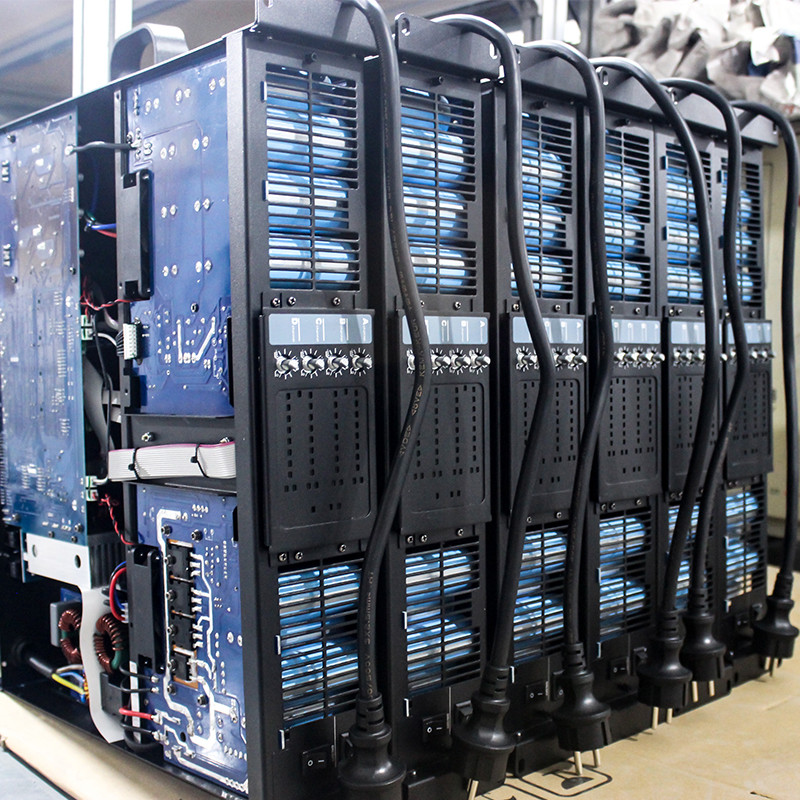 Alt text: Internal view of a robust power supply unit for a professional audio amplifier.
Impact on Audio Performance and Reliability of Professional Stage Power Amplifiers
The quality of the power supply has a direct and audible impact on the final sound produced by the amplifier. It's impossible for a PSU not to affect sound quality. A superior PSU enables the entire system to perform optimally, while a weak one becomes the bottleneck, compromising fidelity.
Maintaining Sound Quality
Sound quality in an amplifier is often defined by its clarity, detail, and dynamic range. The PSU is central to all three. A stable, low-noise power source allows the amplifier's circuitry to reproduce the audio signal with high fidelity. When the PSU can effortlessly supply the current demanded by the music, the result is a sound that is open, detailed, and dynamic. This capability, often referred to as "headroom," is the amp's ability to handle sonic peaks without struggling. An amplifier with a strong power supply will sound "effortless," especially when driving speakers with low impedance, which demand more current.
Preventing Distortion and Noise
Unwanted noise and distortion are the enemies of high-quality audio. The PSU is a primary line of defense against them. There are several types of noise that a PSU must combat:
- Hum: A low-frequency hum (typically 50Hz or 60Hz) can be introduced if the PSU's filtering is inadequate, allowing residual AC ripple to leak into the audio path. It can also be caused by the mechanical vibration of the power transformer itself, a phenomenon known as magnetostriction, which can be exacerbated by DC on the mains power line.
- Buzz: Often a higher-frequency sound than hum, buzz can be caused by problems with grounding within the system (ground loops) or by the PSU's internal components.
- Hiss: A high-frequency noise that can be a result of noisy components within the PSU or the amplifier circuits it powers.
- Distortion: If a PSU cannot supply enough current during high-demand passages, the voltage will sag, causing the audio waveform to be "clipped." This results in harsh distortion and can be damaging to speakers.
A well-designed PSU uses extensive filtering, proper grounding techniques, and high-quality components to deliver exceptionally clean power, ensuring that the only thing you hear is the music.
Crucial Considerations for Selecting a Professional Stage Power Amplifier PSU
Selecting the right power supply unit for a professional stage power amplifier is not a matter of guesswork; it is a calculated decision based on technical specifications. A mismatch between the PSU and the amplifier can lead to poor performance, unreliability, and even catastrophic equipment failure. To ensure optimal performance and longevity, several critical factors must be carefully evaluated.
Voltage and Current Output for Professional Stage Power Amplifiers
The most fundamental specifications of any PSU are its voltage (measured in Volts, V) and current (measured in Amperes, A) ratings. These must precisely match the requirements of the amplifier's internal circuitry.
Matching Amplifier Requirements
Every amplifier is designed to operate at a specific DC voltage. For instance, many power amplifiers use a "split" or "dual" power supply, which provides both a positive and a negative voltage relative to a common ground (e.g., +55V and -55V). It is absolutely critical that the PSU provides the exact voltage(s) specified by the amplifier manufacturer.
- Voltage: The voltage from the PSU must match the amplifier's design voltage. Using a voltage that is too high will almost certainly damage or destroy the amplifier's components. A voltage that is too low may prevent the amplifier from turning on or cause it to perform poorly and produce distorted sound.
- Current: The PSU's current rating must be equal to or, preferably, greater than the maximum current the amplifier will draw. An amplifier's current draw fluctuates with the musical signal and volume. The PSU must be able to supply enough current to handle the highest peaks without strain. If the PSU's current capacity is insufficient, it can become a bottleneck, "starving" the amplifier of power when it needs it most. The basic rule is to match the voltage exactly and ensure the current rating of the PSU meets or exceeds the amplifier's requirement.
| Specification | Rule for Selection | Why It's Important |
|---|---|---|
| Output Voltage (V) | Must exactly match the amplifier's required voltage. | Incorrect voltage can lead to immediate component failure (too high) or malfunction and distortion (too low). |
| Output Current (A) | Must be equal to or greater than the amplifier's maximum current draw. | Provides the necessary power for dynamic peaks, prevents overheating of the PSU, and avoids distortion from power starvation. |
Consequences of Insufficient or Incorrect Power
Using the wrong power supply can have disastrous consequences. Plugging a 12V DC power supply into an amplifier that expects 15V AC can cause immediate and irreparable damage. Even less dramatic mismatches can cause significant problems.
- Under-voltage: If the PSU voltage is too low, the amplifier may not reach its rated power output. The sound may be weak, lack dynamics, and distort prematurely as the internal circuits are not being properly powered.
- Over-voltage: This is extremely dangerous. Excess voltage can quickly overwhelm and burn out sensitive electronic components like transistors, capacitors, and integrated circuits, leading to a completely dead amplifier.
- Insufficient Current: A PSU that cannot provide enough current will struggle under load. This leads to the voltage dropping or "sagging" during loud passages, which causes clipping distortion. It also forces the PSU to work beyond its limits, leading to overheating and potential failure.
Power Output and Stability for Professional Stage Power Amplifiers
Beyond just basic voltage and current, the overall power capability and the stability of that power are what separate a mediocre PSU from a high-performance one.
Exceeding Maximum Consumption
An amplifier's power consumption is not constant. It has a baseline power draw at idle and consumes significantly more power when producing sound. The maximum power consumption occurs during the loudest musical peaks. Therefore, it is crucial to select a PSU with a power rating (measured in Watts) that comfortably exceeds the amplifier's maximum potential draw. Professional audio practice often suggests accounting for a thermal constant of around 1/8th of the full power rating for long-term use. This headroom ensures the PSU is not constantly operating at its absolute limit, which improves reliability and thermal performance.
For example, a typical Class A/B amplifier with a 100-watt output might consume around 25 watts at idle, but its peak consumption could be much higher. A PSU rated for just the average consumption would fail dramatically. A good rule of thumb is to have a PSU capable of delivering at least 25-50% more power than the amplifier's stated maximum consumption.
The Importance of Good Regulation for Professional Stage Power Amplifiers
Power supply regulation refers to the PSU's ability to maintain a constant output voltage despite changes in the input voltage or the load current. Good regulation is critical for consistent audio performance.
When an amplifier reproduces a powerful bass note, it draws a large amount of current from the PSU. An unregulated or poorly regulated supply might experience a temporary voltage "droop" under this heavy load. This voltage drop can reduce the amplifier's available headroom, causing distortion and compressing the dynamics of the music. Conversely, when the load is suddenly released, the voltage can "spike." These fluctuations can push amplifier components outside their optimal operating range, creating noise and distortion. A well-regulated PSU, whether linear or switching, ensures the voltage rails remain stable, providing a solid foundation for the amplifier, which is especially important for the sensitive input stages.
Minimizing Ripple and Noise in Professional Stage Power Amplifiers
A key indicator of a PSU's quality is its ability to deliver pure DC power, free from any residual AC components or other electrical noise.
Understanding Ripple's Effect on Audio
Ripple is the small, periodic fluctuation that remains on the DC voltage after rectification and filtering. It typically occurs at the frequency of the mains power (or double it, e.g., 120Hz in the US). If not properly filtered, this ripple can leak into the audio signal path. No circuit has a perfect ability to reject power supply noise (a specification known as Power Supply Rejection Ratio, or PSRR). Any ripple on the power rails will inevitably appear at the amplifier's output, where it becomes audible as a distinct low-frequency hum. This hum is essentially noise pollution that contaminates the audio and can be especially noticeable during quiet passages or with high-sensitivity speakers.
Achieving Clean Audio Output
Achieving a clean audio output starts with a clean power supply. Several design techniques are used to minimize ripple and noise:
- Sufficient Capacitance: Large filter capacitors are the first line of defense. They smooth the DC voltage and act as reservoirs of energy, helping to suppress ripple.
- LC and Pi Filters: For even better performance, inductor-capacitor (LC) or Pi-type (CLC) filter networks can be used. The inductor resists changes in current, further smoothing the voltage and reducing ripple.
- Shielded Cables and Proper Grounding: Using shielded power cables and ensuring a proper grounding scheme throughout the audio system can prevent external noise from being picked up. Separating power cables from sensitive interconnects is also crucial.
- High-Quality Components: The quality of the transformer, capacitors, and regulators all play a role. Premium components generally have better characteristics for low-noise performance.
Protection Features and Efficiency for Professional Stage Power Amplifiers
A professional-grade PSU must not only perform well but also protect both itself and the amplifier it powers. Efficiency is also a key factor, impacting thermal performance and operational cost.
Safeguarding Equipment with Overcurrent and Overvoltage Protection
Essential protection circuits act as a safety net against common fault conditions.
- Overcurrent Protection (OCP): This circuit monitors the current being drawn from the PSU. If the current exceeds a safe limit (for example, due to a short circuit in the amplifier), the OCP will shut down the power supply to prevent damage.
- Overvoltage Protection (OVP): This circuit monitors the PSU's output voltage. If the voltage rises above a safe level due to a regulator failure or other fault, the OVP will trip, protecting the amplifier from destructive overvoltage.
- DC Protection: Many amplifiers include a circuit that monitors the speaker outputs for any DC voltage. A DC output is a sign of a catastrophic amplifier failure, and if it reaches the speaker, it can destroy the voice coil. This protection circuit will disconnect the speaker via a relay if DC is detected.
Alt text: Diagram of overcurrent, overvoltage, and thermal protection circuits in an amplifier PSU.
Thermal Management and System Compactness
Power supply efficiency is the ratio of output power to input power, with the difference being lost as heat. An 85% efficient PSU converting 100W will dissipate 15W as heat. Higher efficiency is better for several reasons:
- Reduced Heat: More efficient PSUs generate less waste heat. This is critical in a densely packed equipment rack, as excessive heat is the enemy of all electronic components and a leading cause of failure.
- Smaller Heatsinks: Less heat means smaller heatsinks are needed, allowing for more compact and lightweight amplifier designs—a huge advantage for touring systems.
- Lower Operating Costs: An efficient PSU draws less power from the wall for the same output, resulting in lower electricity consumption over the life of the equipment.
Class D amplifiers, for example, are highly prized in professional audio partly because their associated switching power supplies can achieve efficiencies above 90%, a significant improvement over the 50-70% efficiency of many traditional Class AB designs.
Compatibility and Specific PSU Examples for Professional Stage Power Amplifiers
Finally, practical considerations of mains power compatibility and brand reputation are essential parts of the selection process.
Matching Mains Power
Professional audio equipment is used worldwide, where mains voltage standards differ. A PSU intended for stage use should be compatible with various international power grids. Most modern switching power supplies feature a "universal input" that can automatically adapt to voltages from approximately 90V to 265V AC, making them suitable for use in North America (120V), Europe (230V), and other regions. This eliminates the need for external voltage converters or manual switching, simplifying international tours.
Notable PSU Brands and Models
While many amplifier manufacturers design their own integrated power supplies, several brands are renowned for producing high-quality linear and switching PSUs used in both commercial and custom-built amplifiers. Brands recognized for their reliability and performance in the professional audio space include:
- Crown Audio (Harman): Known for their efficient and powerful DriveCore technology.
- QSC: Their amplifiers are known for robust power supplies designed for live sound integration.
- Lab Gruppen: A favorite for touring, known for powerful and road-ready amplifier designs.
- Powersoft: An Italian brand recognized for highly efficient and compact amplifiers, often with advanced thermal management.
For those building or upgrading systems, PSU manufacturers like Seasonic, Corsair, and EVGA are well-regarded in the high-performance computing world, and their principles of delivering stable, clean power are directly applicable to audio. It's crucial to select a model that has undergone rigorous testing and has a proven track record of reliability under demanding conditions.
Troubleshooting Common Issues in Professional Stage Power Amplifiers Related to PSUs
Even the most robust and well-designed professional stage power amplifiers can encounter problems, and very often, the root cause lies within the power supply unit. Since the PSU is the foundation for the entire amplifier's operation, any fault or limitation within it will manifest as a performance issue. Learning to diagnose these power-related problems is a crucial skill for any audio professional.
Diagnosing Power-Related Problems in Professional Stage Power Amplifiers
When an amplifier starts acting up, a systematic troubleshooting process can help you quickly isolate whether the PSU is the culprit.
No Power or Intermittent Operation
This is one of the most common and frustrating issues. The amplifier simply won't turn on, or it powers on and off randomly.
Troubleshooting Steps:
- Check the Obvious First: Before opening the amplifier, check the trivial problems. Ensure the power cord is securely plugged into both the wall outlet and the amplifier's IEC receptacle. Test the outlet with another device to confirm it's working. Try a different power cable that you know is functional.
- Inspect Fuses: Most amplifiers have at least one external fuse, and often internal ones as well. Check the main fuse located on the back panel. If it has blown, replace it with one of exactly the same rating. If the new fuse blows immediately upon powering on, this indicates a serious internal short circuit, very likely in the power supply section, and the amplifier requires professional service.
- Check for Voltage at the Amplifier: Using a multimeter, a technician can check for voltage at the amplifier's power and ground terminals. If there's no voltage, the problem lies with the power source or the external fuse. If voltage is present but the amp won't turn on, the issue is internal.
- Listen for Clicks: Many amplifiers use a protection relay that makes an audible "click" a few seconds after being powered on. If you don't hear this click, it could mean the protection circuit is not disengaging, which is often due to a fault detected by the PSU (like DC on the output) or a failure in the PSU's low-voltage rails that power the protection circuit itself.
- Internal Inspection: For intermittent issues, loose connections are a common cause. A visual inspection inside the amplifier (with the power disconnected) might reveal a broken solder joint or a wire that has come loose from the PSU board.
Distortion and Noise from the PSU in Professional Stage Power Amplifiers
If the amplifier is producing unwanted hum, buzz, or distortion, the PSU is a prime suspect.
Diagnosing the Noise:
- Steady Hum (60Hz/50Hz): This is classic power supply hum. It's often caused by failing filter capacitors in the PSU that are no longer able to smooth out the rectified AC voltage. Aging capacitors can dry out, leading to unstable output and audible ripple. It can also be a grounding issue.
- Buzzing Noise: Buzz is often related to ground loops, which occur when different pieces of equipment are connected to different ground potentials. However, it can also originate from a loosely wound power transformer vibrating mechanically or a fault within the PSU's rectification stage.
- Distortion at High Volumes: If the sound becomes distorted, muddled, or "saggy" only when the volume is turned up, this is a strong sign of an underpowered or failing PSU. The PSU is struggling to supply the current needed for loud passages, causing the voltage to drop and the amplifier to clip.
- Intermittent Crackles or Pops: While often caused by faulty cables or controls, these noises can also be a sign of failing components within the power supply that are breaking down under thermal stress.
To isolate the PSU as the source, disconnect all inputs from the amplifier. If the hum or buzz persists, it's almost certainly being generated internally by the amplifier, with the power supply being the most likely culprit.
Addressing Performance Limitations in Professional Stage Power Amplifiers
Sometimes the amplifier works, but it just doesn't perform as expected. Its output might be weak, or it might shut down during a show. These limitations are frequently tied to the PSU.
Underpowered PSUs and Output Quality
An amplifier is only as powerful as its power supply. Using an amplifier with a PSU that can't deliver sufficient current is a common reason for poor sound quality, especially in demanding live situations.
Symptoms of an Underpowered PSU:
- Lack of Dynamics: The music sounds compressed and lifeless. The punchy transients of drums and bass are softened because the PSU cannot deliver the instantaneous current required. The sound can feel "strained."
- Premature Clipping: The amplifier distorts long before it reaches its advertised maximum volume. When you view the waveform on an oscilloscope, you can see the peaks being flattened or "clipped" because the PSU cannot provide the necessary voltage swing.
- Fried Tweeters: A classic symptom of persistent amplifier clipping from an underpowered PSU is damaged tweeters. The harsh, high-frequency harmonics generated by a clipped waveform can quickly overheat and destroy a tweeter's delicate voice coil.
If you experience these symptoms, especially with speakers that have a low impedance rating (which demand more current), it's a strong indication that the amplifier's PSU is the performance bottleneck.
Overheating and Shutdown in Professional Stage Power Amplifiers
Nearly all professional amplifiers have a thermal protection circuit that will automatically shut the unit down if it exceeds a safe operating temperature. While poor ventilation is a common cause, an overworked PSU is often the real reason for the excess heat.
Troubleshooting Overheating:
- Ensure Proper Ventilation: First, confirm the basics. The amplifier needs several inches of clear space around its vents for proper airflow. Clean any dust from vents and internal fans. Don't operate amps in enclosed cabinets without forced-air cooling.
- Check Speaker Load: An incorrect speaker impedance can cause overheating. For instance, connecting a 4-ohm speaker load to an amplifier jack intended for 8 ohms will force the amplifier to deliver double the current, causing significant strain and heat.
- Evaluate Gain Structure: If the input gain on the amplifier is set too high, it forces the amp to work harder than necessary, leading to overheating.
- Suspect the PSU: If ventilation and speaker load are correct, the overheating is likely due to an inefficient or failing power supply. As PSU components age, particularly capacitors, their internal resistance can increase, causing them to generate more heat. An under-spec PSU will constantly be running at its maximum capacity, generating excessive heat and eventually triggering the thermal shutdown.
Alt text: Technician diagnosing an overheating professional power amplifier.
The Impact of Power Supply Design on Professional Stage Power Amplifier Performance
The design philosophy behind a power supply unit—from its core topology to the specific components chosen—has a profound impact on an amplifier's sonic signature, efficiency, and reliability. Two primary PSU architectures dominate the world of professional audio: the traditional linear power supply and the modern switch-mode power supply (SMPS).
Linear vs. Switching PSUs for Professional Stage Power Amplifiers
The choice between a linear power supply (LPS) and a switch-mode power supply (SMPS) is one of the most significant in amplifier design, with each offering a distinct set of trade-offs.
Advantages and Disadvantages for Audio
Linear Power Supplies (LPS):
- How They Work: Linear supplies are straightforward in design. They use a large, heavy power transformer to step down the 50/60Hz AC mains voltage, which is then rectified, filtered by large capacitors, and sometimes regulated.
- Advantages:
- Low Noise: Their simple design and lack of high-frequency switching make them inherently low in noise and ripple. This "quiet" power is ideal for sensitive audio circuits.
- Excellent Transient Response: The large transformers and capacitor banks can store a massive amount of energy, allowing them to deliver large bursts of current instantly for musical peaks.
- Simplicity and Reliability: With fewer components, they are generally easier to troubleshoot and can be extremely reliable if built with quality parts.
- Disadvantages:
- Inefficiency: Linear supplies are very inefficient, often operating at only 40-60% efficiency. The excess energy is dissipated as heat, requiring large heatsinks.
- Size and Weight: The low-frequency transformer is made of heavy iron and copper, making linear-powered amplifiers extremely heavy and bulky.
- Cost: The sheer amount of copper and iron required for the transformer makes them expensive, especially for high-power applications.
Switch-Mode Power Supplies (SMPS):
- How They Work: An SMPS is a more complex design. It first rectifies the AC mains to high-voltage DC, then uses a switching transistor (MOSFET) to chop it up at a very high frequency (50kHz to over 1MHz). This high-frequency AC is then fed into a much smaller, lighter transformer, and finally rectified and filtered.
- Advantages:
- High Efficiency: SMPS designs are incredibly efficient, often achieving 80-95% efficiency. They waste very little energy as heat.
- Compact and Lightweight: Because they operate at high frequencies, the transformer and filter components can be dramatically smaller and lighter. A 260W SMPS can weigh the same as the transformer alone for an 18W linear supply.
- Wide Input Voltage Range: Most SMPS designs can automatically adapt to different mains voltages across the globe, making them ideal for touring equipment.
- Disadvantages:
- Electrical Noise: The high-frequency switching action is a major source of electromagnetic interference (EMI) and ripple. This noise can interfere with sensitive audio circuits if not meticulously filtered and shielded.
- Complexity: SMPS circuits are far more complex than linear supplies, making them more difficult to repair.
- Initial Cost: The complex circuitry and advanced components can sometimes lead to a higher initial manufacturing cost compared to simple linear designs, though this is often offset by the lower material cost of the transformer.
| Feature | Linear Power Supply (LPS) | Switch-Mode Power Supply (SMPS) |
|---|---|---|
| Efficiency | Low (40-60%) | High (80-95%) |
| Size & Weight | Large & Heavy | Compact & Lightweight |
| Noise Profile | Very Low Noise, Low Ripple | Higher Noise & Ripple (requires filtering) |
| Complexity | Simple, Easy to Repair | Complex, Difficult to Repair |
| Heat Dissipation | High | Low |
| Cost | High (due to heavy materials) | Lower material cost, higher design cost |
| Primary Use | High-fidelity home audio, studio preamps | Professional touring amplifiers, powered speakers |
Mitigating Noise and Interference in Professional Stage Power Amplifiers
The primary challenge for using SMPS in high-quality audio is managing the high-frequency switching noise. Modern amplifier designers employ several strategies to overcome this:
- Advanced Filtering: Using multi-stage filters, including common-mode chokes and LC filters, at both the input and output of the SMPS is crucial to block noise.
- Shielding: Encasing the SMPS section in a metal shield isolates its radiated electromagnetic noise from the sensitive preamplifier and amplifier stages.
- Optimized PCB Layout: Careful circuit board design is used to minimize noise paths and prevent ground loops. Keeping high-current and noisy traces away from signal paths is essential.
- Snubber Circuits: These simple resistor-capacitor networks are placed across switching components to dampen the high-frequency ringing that occurs during switching, reducing spike noise.
With these advanced techniques, a well-designed SMPS can be much quieter than a traditional linear supply, making it the dominant choice for modern, high-power professional stage amplifiers where efficiency and weight are paramount.
Advanced Design Considerations for Professional Stage Power Amplifiers
Beyond the basic topology, the specific components and construction techniques used in a PSU can make a significant difference in performance.
Transformer Choice and Components
For linear power supplies, the type of transformer used is a critical choice.
Toroidal vs. EI-Core Transformers:
- Toroidal transformers are donut-shaped and are generally more efficient, smaller, and lighter than traditional square EI-core transformers. Their key advantage for audio is their extremely low external magnetic field, which prevents hum from being induced into nearby audio circuitry.
- EI-core transformers are less expensive and can be more robust, but they radiate a strong magnetic field that requires careful placement or shielding. While toroids are often preferred for their low stray field, some high-end manufacturers favor specially designed EI transformers, claiming they offer better rejection of mains noise due to lower parasitic capacitance.
Capacitor Quality: The filter capacitors are equally important. Key specifications include capacitance (measured in Farads), voltage rating, and Equivalent Series Resistance (ESR). A lower ESR means the capacitor can deliver its stored charge more quickly, which is vital for good transient response. Using multiple smaller capacitors in parallel is a common technique to reduce the total ESR and improve high-frequency filtering performance.
Grounding and Shielding for Optimal Professional Stage Power Amplifier Performance
Proper grounding and shielding are among the most critical, yet often misunderstood, aspects of amplifier design for preventing noise.
- Star Grounding: This is a technique where all ground connections within the amplifier (power supply ground, signal ground for input and output stages) are brought to a single, central point. This prevents "ground loops," where small voltage differences between different ground points can cause noise currents to flow through signal paths, resulting in hum and buzz.
- Chassis Grounding: The amplifier's metal chassis should act as a shield against external electromagnetic interference. It is typically connected to the central ground point to drain away any induced noise.
- Shielding: Sensitive low-level signal paths, especially at the input stage, should be physically shielded. This can be done by using shielded cables for internal wiring or by surrounding critical parts of the circuit board with a ground plane, creating a Faraday cage effect to block RF interference.
By combining a well-chosen topology with high-quality components and meticulous grounding and shielding practices, designers can create a power supply that serves as a silent, powerful, and unwavering foundation for a world-class professional stage power amplifier.
Frequently Asked Questions (FAQ)
Q1: Is a bigger and heavier power supply always better for a professional stage power amplifier?
Not necessarily, but there's some truth to it. In the context of traditional linear power supplies, a larger and heavier unit usually indicates a massive power transformer and large filter capacitors. This translates to greater power reserves, better ability to deliver high current on demand for musical peaks (transients), and generally lower noise. For a linear design, weight is often a good indicator of a robust build capable of handling demanding loads without voltage sag.
However, modern professional amplifiers increasingly use Switch-Mode Power Supplies (SMPS). These are vastly more efficient, compact, and lightweight than their linear counterparts. A high-power, top-tier touring amplifier with an SMPS can be significantly lighter than a lower-powered linear amplifier, yet deliver superior performance in terms of sustained output and efficiency. In this case, judging by weight is misleading. The quality of an SMPS is determined by its design complexity, filtering, and component quality, not its size.
Q2: What is "ripple" in a power supply, and why is it bad for audio?
Ripple is the residual, small periodic fluctuation of AC voltage that remains on the DC output after the initial conversion from AC. It's essentially leftover AC noise from the mains power that the PSU's filters didn't completely remove. This is bad for audio because the amplifier's circuits can't perfectly reject this noise (a characteristic measured by the Power Supply Rejection Ratio, or PSRR).
As a result, this ripple can leak into the audio signal path and become audible through the speakers. It typically manifests as a low-frequency hum (at 60Hz or 120Hz in the US). This hum contaminates the audio, reduces the signal-to-noise ratio, and can be very distracting during quiet musical passages, diminishing the overall fidelity and clarity of the performance.
Q3: Can I upgrade the power supply in my existing professional stage power amplifier?
Upgrading a power supply is a complex task and generally not recommended for anyone who is not an experienced electronics technician. The PSU in a commercially produced amplifier is specifically designed to match the voltage, current, and physical layout requirements of that particular unit.
- For internal PSUs: A direct drop-in replacement with higher specifications is rarely available. Any upgrade would involve a custom design, requiring deep knowledge of electronics to ensure proper voltage, current capacity, ripple filtering, and safety protection. An incorrect modification could easily destroy the amplifier.
- For external PSUs (wall warts): If your amplifier uses a simple external power adapter, upgrading can be simpler, but you must adhere to strict rules. You must match the output voltage and connector polarity exactly. You can, however, choose a replacement with an equal or higher current (amperage) rating. A higher current rating provides more headroom and may allow the PSU to run cooler, but it will not magically increase the amplifier's power output, which is determined by its internal circuitry.
Q4: What's the difference between a linear power supply and a switching power supply in an amplifier?
They are two fundamentally different technologies for converting AC to DC power.
- Linear Power Supply (LPS): Uses a large, heavy transformer operating at the low mains frequency (50/60Hz). It's simple, reliable, and produces very low noise, but it's inefficient (losing much energy as heat) and very heavy. They were the standard for decades.
- Switch-Mode Power Supply (SMPS): Uses complex circuitry to "chop up" the power at a very high frequency (tens or hundreds of thousands of times per second). This allows for a much smaller, lighter transformer and components. SMPSs are extremely efficient (90%+) and lightweight, but their high-frequency operation can generate electrical noise that must be carefully filtered to be suitable for high-fidelity audio.
Today, due to their efficiency and light weight, well-designed SMPSs are the dominant technology in professional touring and high-power stage amplifiers.
Q5: My amplifier shuts down when I play it loud. Is this a power supply problem?
It very likely is. This symptom is a classic sign of the amplifier's protection circuits being triggered, and the PSU is often at the center of it. There are two main possibilities:
- Thermal Protection: Playing loud forces the amplifier and its PSU to work hard, generating heat. If the PSU is inefficient or underpowered for the task, or if ventilation is poor, the temperature can rise to a point where the thermal protection circuit shuts the amp down to prevent damage.
- Overcurrent Protection: Loud musical passages, especially heavy bass, demand large amounts of current. If the PSU cannot supply the required current, or if there's a problem like a low-impedance speaker load, the current draw can exceed safe limits. The overcurrent protection circuit will then kick in, shutting off the amplifier.
In either case, you should first check for obvious issues like blocked ventilation or incorrect speaker wiring. If those are fine, the shutdown points to a limitation or fault within the PSU-amplifier system.
Conclusion
The power supply unit is much more than just a component; it's the lifeblood of any professional stage power amplifier. Its quality and design directly influence the amplifier's reliability, safety, and most importantly, the clarity and fidelity of the sound it produces. By understanding the key specifications like voltage/current output, power capacity, regulation, ripple, and protection features, we can make informed decisions when selecting or troubleshooting PSUs for our professional stage power amplifiers.
Investing in a high-quality, well-matched PSU is crucial for achieving optimal performance and ensuring the longevity of your professional stage power amplifier, allowing you to deliver an exceptional audio experience every time. We encourage you to share this article with fellow audio professionals and continue the conversation. What has been your experience with different types of power supplies? Let us know in the comments below