
What Are Point Source Speakers? Everything You Should Know for Optimal Sound
As an audio enthusiast, I'm always looking for ways to get the best sound possible. One term you might hear a lot in the audio world is "point source speakers." But what exactly are point source speakers, and how can they help us achieve optimal sound?
In this blog post, I'll dive into the world of point source speakers, explaining what they are, how they work, and why they might be the perfect choice for your audio setup. We'll explore their advantages, ideal applications, and even compare them to other speaker types, so you can make an informed decision for your sound needs. We'll even see how brands like Sinbosen contribute to this technology.
Join me as we uncover everything you should know about point source speakers for an unparalleled listening experience.
Understanding the Fundamentals of Point Source Speakers
Before we can appreciate the benefits of point source speakers, it's essential to grasp the core concepts that define them. At its heart, this technology is about creating a more natural and coherent sound field, much like how we experience sound in the real world. From the underlying physics to their practical design, let's break down what makes a point source speaker unique.
What Defines a Point Source Speaker?
A point source speaker is designed to radiate sound as if it's coming from a single, specific point in space. This is in contrast to other speaker designs where sound might emanate from multiple drivers (like tweeters, mid-range speakers, and woofers) that are physically separated in a cabinet. The goal of a point source speaker is to have all frequencies—from the lowest bass notes to the highest treble—originate from the same location, ensuring they reach the listener's ears simultaneously and in perfect alignment.
This single-point radiation provides uniform dispersion, creating a cohesive sound wave that moves equally in all directions, regardless of the frequency. In the professional audio world, this is often achieved through a single, self-contained enclosure that houses all the necessary components to reproduce sound. This fundamental design choice has profound implications for how we perceive the audio they produce.
The Physics Behind Point Source Sound
The term "point source" is borrowed from physics, where it describes an energy source of negligible size that radiates energy uniformly outward. For sound, this creates a spherical wavefront, like the ripples spreading from a pebble dropped in a pond. As this spherical wave travels, its energy spreads over an increasingly larger area.
This behavior is governed by the Inverse Square Law, a fundamental principle in acoustics. The law states that for every doubling of the distance from the source, the sound intensity decreases by 6 decibels (dB), which equates to a 75% drop in audio power. This predictable drop-off happens because the same initial energy must cover a surface area that is four times larger. While real-world rooms with reflective surfaces alter this perfect model, the inverse square law is the foundational principle for how sound from a point source propagates in a free field.
How Point Source Speakers Recreate Realistic Audio
The magic of point source speakers lies in their ability to achieve phase coherence. When different frequencies originate from separate physical locations, as in many conventional multi-driver speakers, they can arrive at the listener's ears at slightly different times. This time-smearing can compromise the integrity of the original sound.
True point source designs, especially coaxial models where the tweeter is placed in the center of the woofer, ensure that all parts of the audio spectrum are perfectly time-aligned. This coherence creates a more natural sound that is closer to how we experience a single acoustic event, like a person's voice or a solo instrument, in real life. The result is a highly realistic soundstage with pinpoint imaging, where instruments and voices are clearly defined and located in space. Listeners benefit from a stable, focused audio image, making the experience more immersive and believable.
Key Characteristics of Point Source Speakers
Beyond the physics, point source speakers are defined by a set of practical characteristics that influence their performance and application. These traits—directivity, focus, compact design, and ease of installation—are direct results of their single-point-of-origin design philosophy. Understanding these features helps clarify why they are so effective in certain environments.
Directivity and Focus of Point Source Speakers
Point source speakers are known for their clear and controllable directivity. Because the sound emanates from a single point, they can effectively focus acoustic energy into a specific area, enhancing sound positioning and clarity. Many designs incorporate horns or waveguides to precisely manage the dispersion pattern, directing sound toward the audience and away from reflective surfaces like walls and ceilings. This controlled radiation minimizes unwanted echoes and reverberation, which is crucial for maintaining speech intelligibility and musical detail.
The directivity pattern is often symmetrical, meaning the sound disperses evenly both horizontally and vertically. This predictable coverage makes it easier for system designers to model and achieve consistent sound throughout the listening area, reducing the number of speakers needed to cover a room effectively.
Compact Structure and Installation Ease with Point Source Speakers
One of the most practical advantages of point source speakers is their typically compact and self-contained design. Most point source systems consist of a single cabinet per side, which simplifies setup and installation significantly compared to more complex systems like line arrays. This makes them highly versatile and portable, an ideal choice for mobile DJs, local bands, and temporary event setups.
Their smaller size and weight not only make them easier to handle but also reduce the complexity of rigging and cabling. For permanent installations in venues like schools, conference rooms, or small churches, their straightforward design leads to quicker installation times and lower overall costs.
The Advantages of Choosing Point Source Speakers for Your Audio System
Opting for point source speakers brings a host of benefits that impact both sound quality and practical implementation. Their ability to deliver a coherent and natural audio experience is matched by their cost-effectiveness and versatility, making them a compelling choice for a wide range of audio applications.
Why Point Source Speakers Offer Excellent Sound Quality
The superior sound quality of point source speakers can be traced back to their core design principle: delivering all frequencies from a single point. This approach minimizes distortion and creates a soundstage that is both precise and expansive, leading to a more engaging and lifelike listening experience.
Achieving Realistic Sound Restoration with Point Source Speakers
Point source speakers excel at realistic sound restoration because they maintain phase coherence across the entire frequency spectrum. By ensuring all sound waves from the tweeter and woofer are time-aligned, they avoid the phase cancellation and interference that can occur in traditional speakers with separated drivers. This alignment results in an exceptionally clean transient response, meaning the speaker can accurately reproduce the sharp, sudden attacks of sounds like drum hits or plucked strings.
This reduction in distortion and time-domain smear allows for a sound that is more natural, transparent, and true to the original recording. The audio is perceived as coming from a single, unified source, which greatly enhances the sense of realism and immersion for the listener.
Clear Positioning and Wider Sweet Spot with Point Source Speakers
A major advantage of point source speakers is their ability to create a clear, stable stereo image. Because the sound from each speaker originates from a precise point, the brain can easily process the location of instruments and vocals on the soundstage. This leads to what audio professionals call "pinpoint imaging," where every element in the mix has a distinct and stable position.
Furthermore, many point source designs, particularly coaxial ones, create a "wider sweet spot." A sweet spot is the ideal listening position where the stereo image is perfectly balanced. With point source speakers, the sound remains more consistent even when the listener moves off-axis, making them more forgiving of listener placement and ideal for situations where multiple people are listening. This is because the symmetrical dispersion ensures that the tonal balance doesn't change dramatically as you move around the room.
Practical Benefits of Point Source Speakers
Beyond their sonic performance, point source speakers offer tangible advantages in terms of cost, simplicity, and flexibility. These practical benefits make them an attractive option for a wide array of users, from home audio enthusiasts to professional sound engineers working on a budget.
Cost-Effectiveness and Simplicity of Point Source Speaker Setup
Compared to large-scale line array systems, point source speakers are generally more budget-friendly. A typical setup requires fewer speaker cabinets, less complicated rigging hardware, and often simpler digital signal processing (DSP). This not only reduces the initial investment but also lowers ongoing maintenance and operational costs.
The simplicity extends to setup and operation. For small to medium-sized events, a pair of point source speakers can often be set up on stands in minutes, without the need for specialized technicians or complex alignment software. This "plug-and-play" nature makes them an excellent choice for schools, local music clubs, and mobile applications where efficiency is key.
Versatility of Point Source Speakers in Various Applications
The versatility of point source speakers is one of their strongest assets. Their ability to provide high-quality, full-range sound from a compact enclosure makes them suitable for an incredibly diverse range of applications. You'll find them used effectively in:
- Small to medium live music venues and clubs.
- Houses of worship for both music and spoken word.
- Corporate AV and conference rooms where speech clarity is paramount.
- Theaters and performing arts centers as main speakers, fills, or delays.
- High-end home audio and home theater systems.
- Stage monitors for performers on stage.
This adaptability means that a high-quality point source speaker can be a valuable tool for rental companies and installers who serve a variety of clients and venue types.
Optimal Applications for Point Source Speakers
While point source speakers are highly versatile, they truly shine in specific environments where their unique characteristics provide the greatest benefit. Understanding these ideal scenarios—and when another type of speaker might be more appropriate—is key to designing a sound system that delivers exceptional results.
Ideal Environments for Point Source Speakers
Point source speakers are the go-to solution for many common sound reinforcement challenges. Their design is particularly well-suited for spaces where controlled coverage and high intelligibility are more important than long-distance projection.
Point Source Speakers in Small to Medium Venues
For small to medium-sized venues like clubs, school auditoriums, and local theaters, point source speakers are often the perfect fit. In these spaces, the goal is to provide even sound coverage for an audience that isn't spread over a vast distance. A single pair of high-quality point source speakers can often cover a wide area effectively thanks to their broad dispersion patterns.
Their ease of setup and cost-effectiveness make them a practical choice for venues with limited budgets or those that require a portable system. Because long-throw capability is not the primary need, the natural 6 dB drop-off in volume per doubling of distance is manageable and predictable within these environments.
Enhancing Speech Intelligibility with Point Source Speakers
One of the standout applications for point source speakers is voice reinforcement. In environments like conference rooms, lecture halls, and houses of worship, clarity of the spoken word is critical. Point source speakers excel here because their coherent, single-point origin minimizes acoustic interference known as comb filtering. Comb filtering can make speech sound hollow and unintelligible, an issue that can arise when sound from multiple, separated sources combines destructively.
By providing a clean, direct sound, point source speakers ensure that every word is heard with pristine clarity. Their ability to focus sound on the audience and away from reflective surfaces further enhances intelligibility in acoustically challenging spaces.
When to Consider Other Speaker Types: Point Source vs. Line Array
While point source speakers are incredibly capable, they are not the solution for every audio problem. For large-scale events, it's important to understand the capabilities of other speaker types, most notably line arrays, to make an informed decision.
Understanding Line Array Speakers
Line array speakers consist of multiple, identical speaker elements stacked vertically in a line. By working together, these elements create a much more controlled and cohesive wavefront than a single speaker could. The primary goal of a line array is to project sound over long distances with minimal loss in volume and clarity.
They achieve this by creating a cylindrical wavefront, which loses volume at a rate of only 3 dB per doubling of distance, as opposed to the 6 dB loss of a point source speaker's spherical wave. This makes them ideal for large venues, outdoor concerts, and festivals where sound must travel hundreds of feet to reach the entire audience.
Making the Right Choice: Point Source Speakers or Line Arrays?
Choosing between point source and line array speakers depends entirely on the specific needs of the event and venue. There is no single "better" option; the right choice is the one that best matches the application.
Here is a table to help guide your decision:
| Feature | Point Source Speakers | Line Array Speakers |
|---|---|---|
| Ideal Venue Size | Small to medium (e.g., clubs, theaters, churches) | Large to very large (e.g., arenas, stadiums, festivals) |
| Sound Propagation | Spherical wave; 6 dB loss per distance doubling | Cylindrical wave; 3 dB loss per distance doubling |
| Vertical Coverage | Wide and fixed | Narrow and controllable |
| Setup Complexity | Simple, fast setup; often "plug-and-play" | Complex; requires skilled technicians and software |
| Cost | More budget-friendly | Higher initial investment and setup costs |
| Best For… | High clarity in smaller spaces, speech intelligibility | Long-throw applications and even coverage for large crowds |
In many cases, a hybrid system may be the optimal solution, using line arrays for the main coverage and point source speakers for front fills or delays to cover areas missed by the main system.
Maximizing Your Sound with Sinbosen Point Source Speakers
Understanding the theory behind point source speakers is one thing; putting it into practice with high-quality equipment is another. Brands like Sinbosen are at the forefront of developing innovative and powerful point source solutions that cater to the demanding needs of professional audio environments. By combining advanced design with practical features, they help audio engineers achieve superior sound.
Sinbosen's Contribution to Point Source Technology
Sinbosen has embraced the core principles of point source audio while pushing the boundaries of performance and flexibility. Their commitment to quality and innovation is evident in their speaker designs, which are engineered for reliability and exceptional sonic performance in a wide variety of professional settings.
Innovations in Sinbosen Point Source Speaker Design
Modern point source speaker design focuses on maximizing efficiency, controlling dispersion, and ensuring robust performance. Sinbosen incorporates these innovations through the use of high-quality driver components, advanced crossover networks, and rugged cabinet construction. Their designs often feature precisely engineered waveguides and horns that ensure smooth, predictable coverage, allowing for optimal sound distribution in any venue.
By focusing on details like phase alignment and power handling, Sinbosen creates speakers that deliver clear, impactful audio even at high volumes. This dedication to advanced acoustic engineering ensures their speakers meet the high standards required for professional live sound and installation projects.
Sinbosen Point Source Speakers for Professional Audio Setups
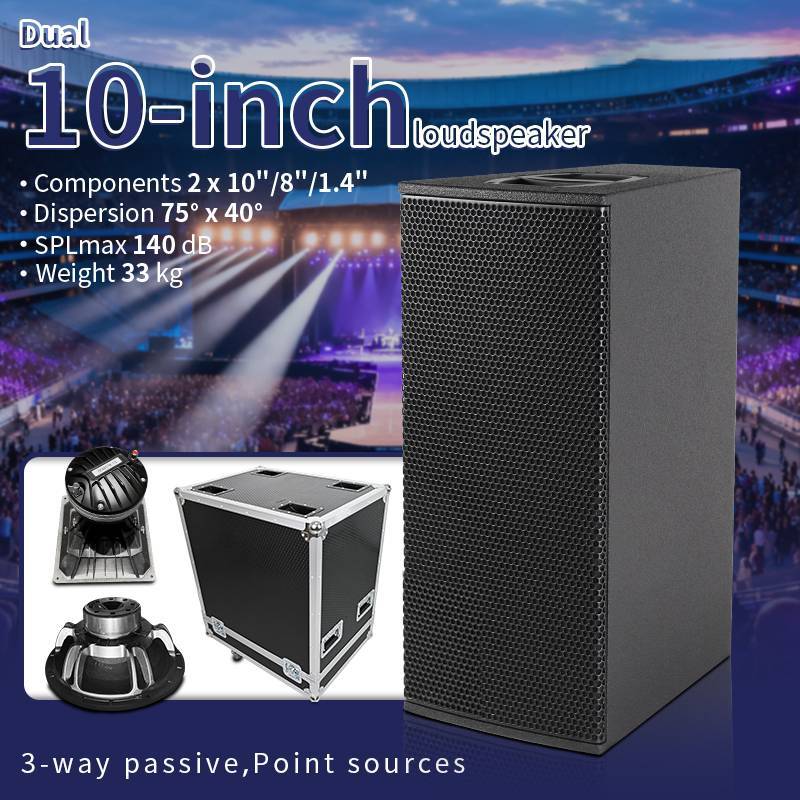
For audio professionals who need reliable, high-performance tools, Sinbosen offers a range of point source speakers designed for demanding applications. A standout model is the V-7, a dual 10-inch, 3-way passive point source loudspeaker. Its sophisticated design provides exceptional clarity and output from a relatively compact enclosure, making it a superb choice for theaters, houses of worship, and live music venues where audio fidelity is paramount. The 3-way configuration ensures that different parts of the frequency spectrum are handled by dedicated drivers, resulting in a detailed and balanced sound.
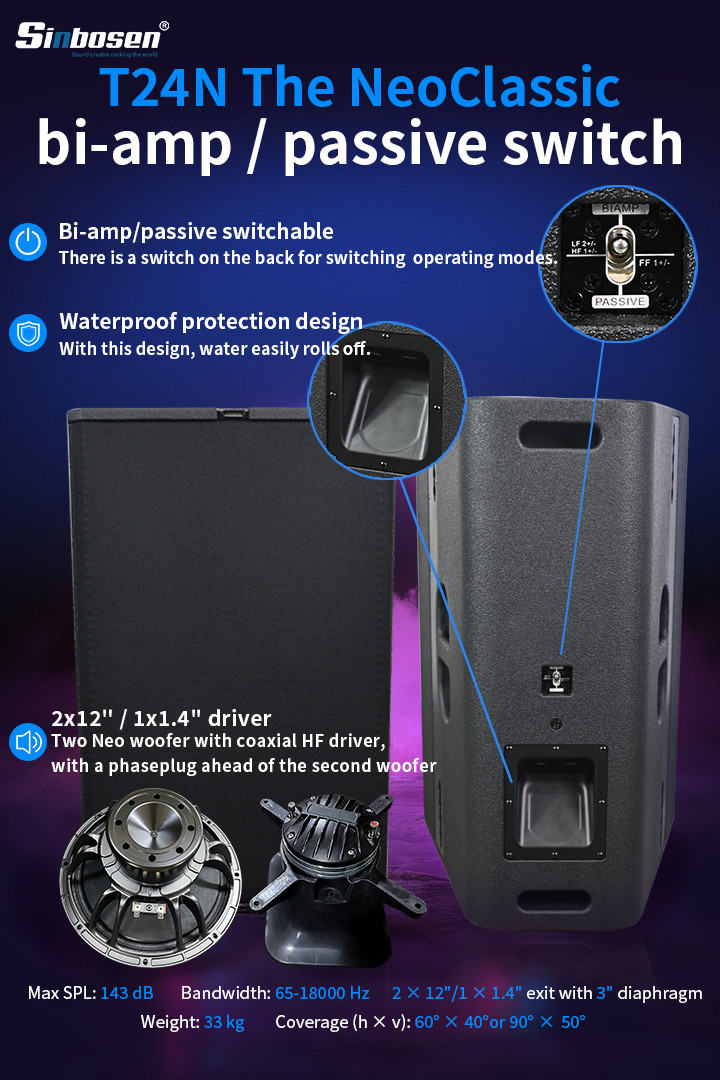
For even more demanding situations requiring high power and significant low-frequency extension, the TN-24 is an excellent option. This professional bi-amp dual 12-inch loudspeaker is built to deliver powerful, full-range sound for larger club events or as a potent component in a distributed sound system. Its robust construction and high output capabilities make it a workhorse for any professional audio inventory.
Tips for Optimal Placement and Configuration of Point Source Speakers
Getting the most out of any point source speaker, including those from Sinbosen, requires proper placement and configuration. Correct setup is crucial for achieving even coverage, avoiding problematic acoustic interactions, and delivering the best possible listening experience for the entire audience.
Achieving Even Coverage with Point Source Speakers
Properly aiming and positioning your point source speakers is fundamental to good sound. Here are some key tips:
- Aim for the Audience: Ensure speakers are aimed directly at the listening area. The central axis of the speaker should typically be pointed toward the back of the audience to ensure balanced coverage from front to back.
- Mind the Splay: When using multiple speakers to cover a wide area, carefully calculate the splay angle between them. Overlapping their coverage patterns too much can cause comb filtering, while leaving a gap will create a "hole" in the sound field.
- Use Delays for Fills: In larger or irregularly shaped rooms, use additional smaller point source speakers as "delay" or "fill" speakers to cover areas shadowed by the main system, such as under balconies. Time-aligning these fills with the main speakers using a DSP is essential for a seamless experience.
- Height Matters: Place speakers high enough to project over the heads of the front rows of the audience. This helps ensure that people in the back receive clear, direct sound.
Integrating Sinbosen Point Source Speakers for Superior Performance
To unlock the full potential of high-quality passive speakers like the Sinbosen V-7 and TN-24, you must integrate them correctly with amplifiers and processors.
- Match Amplifiers to Speakers: Ensure your power amplifier can provide adequate, clean power to the speakers. Underpowering a speaker can lead to clipped, distorted signals that can damage the drivers. Refer to the speaker's specifications for recommended amplifier power.
- Utilize Digital Signal Processing (DSP): A DSP is your most powerful tool for system tuning. Use it to set crossovers (especially for bi-amp models like the TN-24), apply equalization (EQ) to correct for room acoustics, and implement time alignment for any fill or delay speakers.
- Proper Gain Structure: Set a proper gain structure from your mixer to the DSP and then to the amplifiers. This will maximize your system's signal-to-noise ratio and prevent clipping and distortion at any stage in the signal chain.
By following these guidelines, you can transform a collection of high-quality components into a finely tuned, cohesive sound system that delivers superior performance every time.
As we’ve explored, point source speakers offer a unique set of advantages, from their ability to deliver realistic and focused sound to their compact design and cost-effectiveness. They are a fantastic choice for many applications, especially in smaller to medium-sized venues or wherever clear speech intelligibility is key.
By understanding the science and practical benefits behind point source speakers, you're now better equipped to make informed decisions for your audio needs. Whether you're setting up a home theater, a live event, or a conference room, considering point source speakers, like those from Sinbosen, can elevate your sound experience.
I hope this guide has shed some light on the power and versatility of point source speakers. If you found this article helpful, please share it with fellow audio enthusiasts! Happy listening